Most AI engineer resumes fail before a human ever reads them. They fail in the ATS. They fail in the 6-second recruiter scan. They fail because they read like a course catalog instead of a track record.
Here's what works in 2026, based on patterns from job postings, recruiter interviews, and the resumes that land interviews at top AI companies.
The 6-Second Rule Still Applies
Recruiters at companies hiring AI engineers review 200+ resumes per open role. They spend an average of 6 seconds on their first pass. Your resume needs to survive that pass, and it won't if the top third is a wall of buzzwords.
The top third of your resume should contain three things:
- Your current title and company
- One quantified achievement involving AI/ML in production
- The technical stack that matters most for the role
What Recruiters Scan For
Based on conversations with AI hiring managers and technical recruiters, the priority scan order is:
- Current company and title (credibility signal)
- Production experience (did you ship, or just experiment?)
- Specific technical stack (do you match what we need?)
- Scale indicators (how big were the systems you built?)
- Education (last, and often optional for applied roles)
Structure That Works
The "Impact First" Format
Every bullet point under a role should follow the pattern: what you did + what it changed + at what scale.
Bad: "Developed machine learning models using PyTorch and deployed them to production."
Good: "Built a fraud detection pipeline in PyTorch that processed 2.3M transactions daily, reducing false positives by 34% and saving $1.2M annually in manual review costs."
The difference is specificity. The first tells a recruiter you've heard of PyTorch. The second tells them you've shipped something that mattered.
Sections to Include
Experience (60% of resume space). This is where you win or lose. Each role should have 3-5 bullets maximum, each containing a measurable outcome. If you can't measure it, describe the scope: team size, data volume, request throughput, latency targets. Technical Skills (10% of resume space). Keep this tight. Group by category: Languages, Frameworks/Libraries, Infrastructure, Cloud. Don't list every tool you've touched once. List what you could discuss in depth during a technical interview. Projects (15% of resume space). This section is critical for career changers and engineers with less than 3 years of experience. Focus on projects that demonstrate production thinking: monitoring, testing, deployment, not just model accuracy. Education (10% of resume space). Degree, institution, year. Relevant coursework only if you're early career. GPA only if it's above 3.7 and you graduated within the last 3 years. Publications/Open Source (5% of resume space). Only include if relevant. A paper on transformer architectures matters if you're applying for an LLM role. Your undergraduate thesis on social network analysis doesn't.Technical Skills: What to List and What to Skip
The instinct is to list everything. Resist it. A 40-item skills section signals that you're either padding or can't distinguish between expertise and exposure.
Always Include (if true)
- Python (still appears in 89% of AI engineering job postings)
- PyTorch or TensorFlow (specify which; they're not interchangeable signals)
- Cloud platform (AWS, GCP, or Azure with specific services: SageMaker, Vertex AI, not just "AWS")
- Docker and Kubernetes (if you've used them, not just followed a tutorial)
- SQL (underrated, but data engineers will tell you it's the most important skill they look for in cross-functional hires)
Include If Relevant to the Role
- RAG frameworks (LangChain, LlamaIndex)
- Vector databases (Pinecone, Weaviate, Chroma)
- MLOps tools (MLflow, Weights & Biases, Kubeflow)
- CUDA/GPU programming
- Specific model architectures you've worked with
Skip
- Excel (assumed)
- "Machine Learning" as a skill (that's the job, not a skill)
- Tools you used once in a tutorial
- Programming languages you learned in college but haven't touched since
The Portfolio Problem
Hiring managers increasingly look beyond the resume. 67% of AI engineering job postings mention GitHub profiles, portfolios, or open-source contributions.
But most AI portfolios are useless. They're full of Jupyter notebooks that train MNIST classifiers and Titanic survival predictors. These prove you completed a tutorial. They don't prove you can build software.
What a Strong AI Portfolio Looks Like
A portfolio that helps you get hired has 2-3 projects that demonstrate:
- End-to-end deployment: model training, API serving, monitoring, documentation
- Real-world messiness: handling missing data, edge cases, model degradation
- Engineering discipline: tests, CI/CD, clean code structure, README with architecture diagrams
GitHub Profile Optimization
Your GitHub profile is a resume supplement. Pin your best 3-4 repositories. Write proper README files with architecture diagrams, setup instructions, and performance metrics. Use conventional commit messages. Show that you write code like a professional, not a student.
Contribution activity matters less than quality. A green contribution graph full of trivial commits is transparent. Two serious projects with thoughtful commits tell a better story.
ATS Optimization Without Keyword Stuffing
Applicant Tracking Systems parse resumes for keyword matches. The temptation is to stuff your resume with every term from the job posting. Don't. Modern ATS tools and the recruiters who use them can spot this.
Instead:
- Mirror the job posting's language naturally. If the posting says "large language models," use that phrase instead of "LLMs" at least once.
- Use both acronyms and full terms. Write "Natural Language Processing (NLP)" the first time, then "NLP" after.
- Match the seniority language. Senior postings mention "architecture," "strategy," "mentorship." Junior postings mention "implementation," "collaboration," "learning."
- Include the specific tools mentioned. If the posting lists "Ray" and "Kubernetes," those exact words should appear in your resume.
Format for ATS Compatibility
Use a single-column layout. ATS tools struggle with multi-column formats, tables, and complex formatting. Stick with:
- Standard section headers (Experience, Education, Skills)
- Simple bullet points
- No graphics, icons, or images
- PDF format (not Word, not Google Docs export)
- Standard fonts (Calibri, Arial, Georgia)
Common Mistakes That Kill AI Resumes
Listing Models Instead of Outcomes
"Fine-tuned GPT-4, BERT, and LLaMA models" tells a recruiter nothing useful. Fine-tuned them for what? With what result? At what scale? Every model mention should connect to a business outcome or technical achievement.
Overemphasizing Research in Applied Roles
If you're applying for an applied AI engineering role, leading with your research publications is the wrong move. Research experience is a supporting signal, not the main event. Lead with what you've shipped.
One Resume for Every Application
This is the single most common mistake. Each application should get a tailored resume that emphasizes the skills and experiences most relevant to that specific role. The core content stays the same, but the ordering, emphasis, and keyword alignment should shift.
At minimum, customize:
- The order of your bullet points under each role
- Which projects you highlight
- Your technical skills section (reorder to match the posting)
Ignoring the Cover Letter Entirely
Cover letters are optional at most companies. But when a posting asks for one, skipping it is a negative signal. When you do write one, keep it to 3 paragraphs: why this company, what you bring, and one specific insight about their AI challenges that shows you've done research.
Resume Length: The Honest Answer
One page if you have less than 5 years of experience. Two pages if you have more. Never three. The two-page limit applies even if you have 20 years of experience. Edit ruthlessly. If a role from 2015 isn't relevant to AI engineering, cut it to one line or remove it entirely.
What Happens After the Resume
Your resume gets you the interview. It doesn't get you the job. But without a resume that survives the ATS, passes the 6-second scan, and communicates production impact, you'll never get to show what you can do.
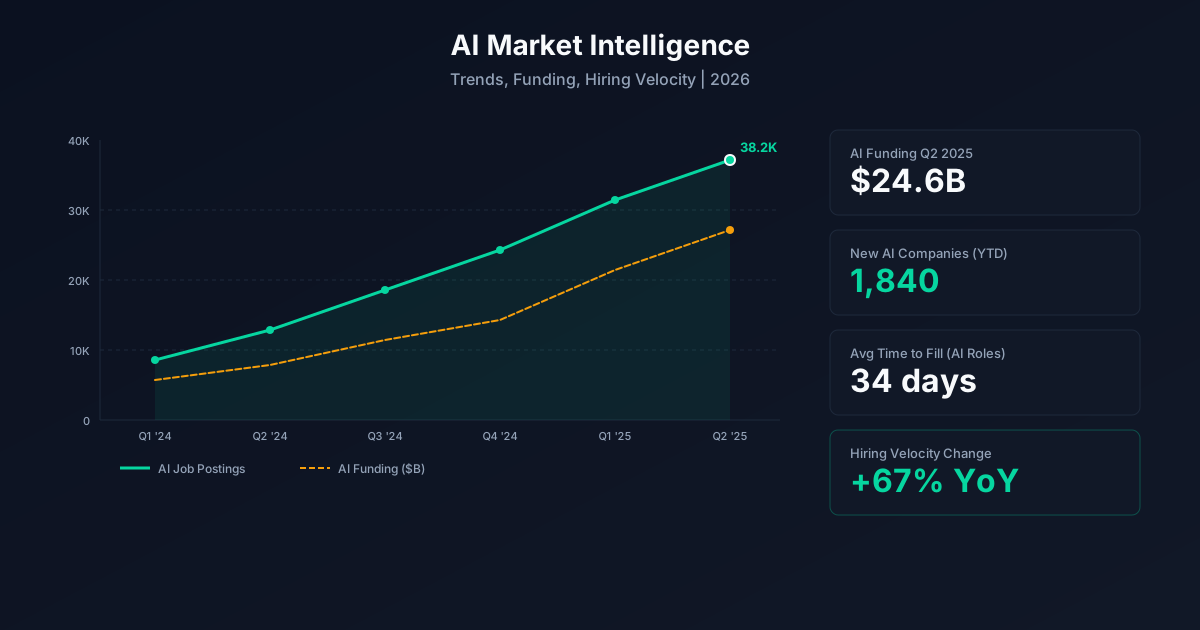
The AI job market in 2026 is competitive but not closed. Companies posted 14,000+ AI engineering roles in Q1 alone. The engineers who land those roles aren't necessarily the most skilled. They're the ones who communicate their skills most effectively on paper.
That's a writing problem, not a technical one. And writing problems have solutions.
How AI Pulse data is built
Every number in this article comes from a continuously updated dataset of 10,827 weekly job postings across 42 roles and 14 industries. Salary figures are derived from postings that disclose compensation. AI penetration percentages reflect the share of postings in each function that explicitly require or prefer AI skills. Premium calculations compare median compensation for AI-skilled postings against same-function, same-seniority postings without AI requirements.
Sources & notes. AI Pulse weekly job posting index (n=10,827). Salary disclosure rate: 6.4%. Premium calculations require minimum n=20 postings per role-seniority cell. Updated weekly.
Last updated: 2026-03-29.
How this fits into the bigger career picture
Every article on AI Pulse connects back to the same dataset on AI adoption, salary premiums, and role trajectories. If you're early in your career thinking, the research index covers the full set of insights articles. If you're closer to a job move, the AI by role grid maps the adoption rate and salary premium for every function we track.
The pages that combine the data into a strategic read are the ai-for-* role hubs. Each one synthesizes the adoption story, salary thesis, displacement risk, and the strategic move for that function. If this article is about a specific role, browse the matching hub for the full picture: AI for engineering, marketing, sales, data and analytics, product management, and 19 more.