Everyone wants to be an AI engineer. Few want to be the person who makes AI engineering possible. That's the AI infrastructure engineer, and right now it's one of the most undersupplied roles in the industry.
What AI Infrastructure Engineers Do
An AI infrastructure engineer builds the systems that let ML models run in production. Not the models themselves. The platforms, pipelines, and compute layers underneath them.
Think of it this way: the AI engineer picks the restaurant. The ML engineer cooks the food. The AI infrastructure engineer built the kitchen, installed the ovens, and makes sure the gas lines don't explode.
Day-to-day work includes:
- Designing GPU cluster architecture for model training and inference
- Building and maintaining ML training pipelines that handle terabytes of data
- Optimizing model serving for latency and throughput
- Managing Kubernetes clusters purpose-built for AI workloads
- Setting up monitoring, logging, and cost tracking for compute-heavy systems
- Implementing model versioning and deployment automation
Why Demand Is Spiking
Two things happened simultaneously. First, companies moved from AI experimentation to production deployment. A proof-of-concept running on a single GPU in a notebook doesn't need infrastructure engineering. A production system handling 10,000 inference requests per second does.
Second, the cost of AI compute became impossible to ignore. Companies spending $50K-$500K monthly on GPU cloud bills suddenly needed people who could optimize those costs. That's not an ML problem. It's an infrastructure problem.
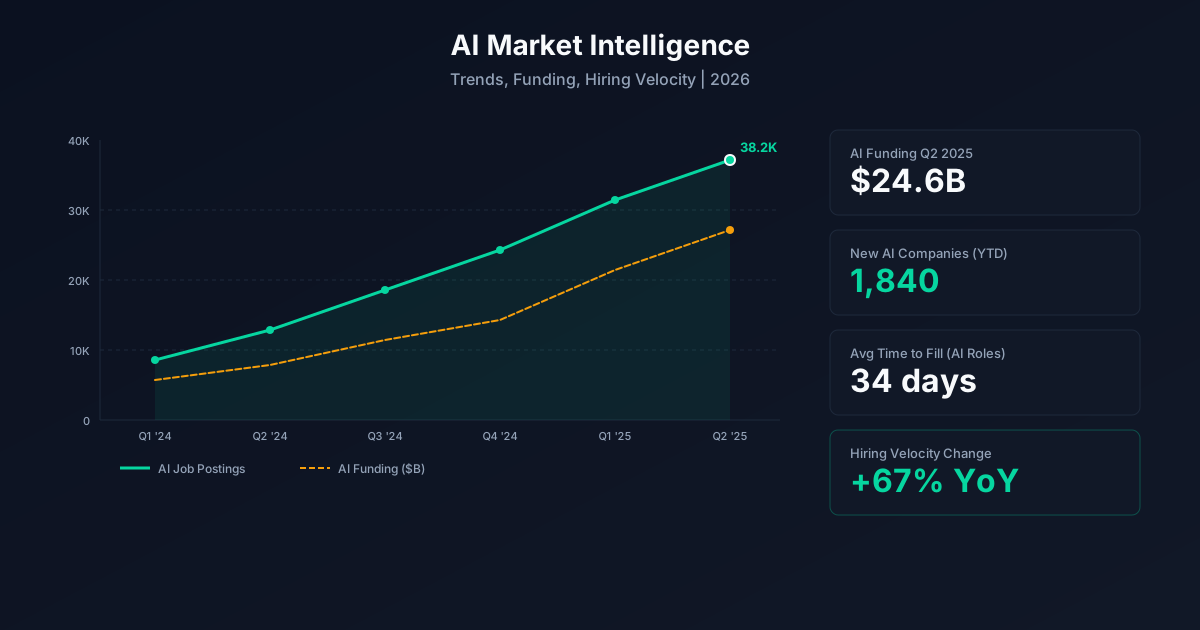
Our data shows AI infrastructure and platform engineering roles grew 47% year-over-year in job postings, outpacing pure ML research roles which grew just 12%. The market is speaking clearly about what it needs.
The Supply Gap
Most engineers who could fill this role are either:
- Working as ML engineers who see infra work as a step backward
- Working as DevOps/SRE engineers who don't have ML-specific knowledge
- Working at FAANG companies with no reason to leave
Salary Benchmarks
AI infrastructure engineer compensation varies significantly by company stage and location, but the ranges are consistently strong.
By Seniority
- Mid-level (2-4 years): $155K-$200K base + equity
- Senior (5-8 years): $200K-$270K base + equity
- Staff/Principal (8+ years): $270K-$380K base + significant equity
By Company Type
Big Tech (Google, Meta, Amazon): Highest total compensation, typically $300K-$500K+ for senior roles when including RSUs. These teams are the most mature. You'll work on systems processing billions of inference calls daily. AI-native companies (OpenAI, Anthropic, Cohere): Competitive base with substantial equity upside. Senior roles range $250K-$350K base. The equity component can be worth multiples of base if the company succeeds. Enterprise companies deploying AI: $180K-$280K for senior roles. Less equity upside but more stability. You're usually building infrastructure from scratch, which means more influence over architecture decisions. Startups: $150K-$230K base with larger equity grants. High variance. You might be the only infrastructure person, which means wearing many hats but also having significant ownership.Remote vs On-site
Approximately 38% of AI infrastructure roles offer remote options. That's lower than the overall AI job market average of about 42%, because many companies want infrastructure engineers close to the physical hardware and on-call teams. Remote roles that do exist tend to pay within 5-8% of their on-site equivalents.
Required Skills
Non-negotiable
- Kubernetes at an advanced level. Not just deploying pods. Managing GPU scheduling, custom operators, resource quotas, and multi-tenancy for ML workloads.
- Cloud platforms (AWS, GCP, or Azure). Deep knowledge of compute services, networking, storage tiering, and cost optimization. Most employers want at least two.
- Python for tooling and automation. You won't be writing models, but you'll be writing the infrastructure code that supports them.
- Linux systems administration. GPU driver management, kernel tuning, networking configuration.
- CI/CD and deployment pipelines. Model deployment is different from application deployment. You need to understand both.
Highly Valued
- CUDA and GPU programming fundamentals. You don't need to write CUDA kernels daily, but understanding GPU memory management, compute use, and multi-GPU training bottlenecks separates good infra engineers from great ones.
- Ray, Kubeflow, or MLflow experience. These are the MLOps tools that bridge ML code and infrastructure.
- Terraform or Pulumi for infrastructure-as-code. Managing GPU clusters manually doesn't scale.
- Monitoring and observability (Prometheus, Grafana, Datadog). ML-specific metrics like model latency, throughput, and drift detection are table stakes.
- Cost optimization. Knowing how to use spot instances for training, right-size GPU allocations, and implement auto-scaling for inference.
Emerging Skills
- vLLM, TGI, and LLM serving frameworks. As companies deploy their own LLMs, optimizing inference serving has become a distinct skill.
- NVIDIA Triton Inference Server. The standard for high-performance model serving.
- Multi-cloud and hybrid deployments. Many companies run training on one cloud and inference on another for cost and latency reasons.
Career Path
How to Get Here
From DevOps/SRE: This is the most common path. You already know Kubernetes, cloud, and production systems. The gap is ML-specific knowledge: understanding training pipelines, model serving patterns, and GPU compute. A focused 3-6 month ramp-up studying MLOps frameworks and completing a project deploying a model serving pipeline will get you interviews. From ML Engineering: If you're an ML engineer who enjoys the deployment side more than the modeling side, this is a natural transition. You already understand the ML workflow. The gap is deeper infrastructure skills: advanced Kubernetes, networking, and systems optimization. From Backend Engineering: Possible but requires the most ramp-up time. You'll need both ML workflow understanding and infrastructure skills. Plan for 6-12 months of dedicated learning.Where It Goes
AI infrastructure engineering opens several senior paths:
- Staff/Principal AI Infrastructure Engineer ($350K-$500K+). Deep technical leadership. You architect the systems that entire AI teams build on.
- AI Platform Engineering Manager ($280K-$400K+). Leading a team of infrastructure engineers. Strong option if you have leadership ambitions.
- Head of AI Infrastructure ($300K-$450K+). Director-level role at companies where AI is a core product. You own the budget, the team, and the technical strategy.
- CTO at an AI startup. Several current AI startup CTOs came from infrastructure backgrounds because the hardest part of building an AI company is making the systems work at scale.
Interview Process
AI infrastructure interviews combine systems design with ML-specific knowledge. Expect:
Technical Screens
- System design: "Design a model serving platform that handles 50K requests per second with sub-100ms latency." They want to see GPU allocation strategy, load balancing, caching, and fallback logic.
- Kubernetes deep dive: Multi-GPU scheduling, custom resource definitions, node affinity for GPU workloads.
- Troubleshooting scenarios: "Training jobs are failing after 4 hours with OOM errors on 8xA100 nodes. Walk us through diagnosis."
Coding
- Python scripting for infrastructure automation
- Sometimes Go for Kubernetes operators or custom tooling
- Rarely algorithm questions, but some companies still include them
Behavioral
- Incident management and on-call experience
- Cross-team collaboration (you'll work with ML engineers, data engineers, and SREs)
- Cost optimization decisions you've made and their impact
Companies Hiring Now
The companies with the largest AI infrastructure teams and most frequent openings include:
- Google DeepMind and Google Cloud AI - Largest AI infrastructure org in the world
- Meta FAIR and Meta AI - Heavy investment in open-source model training infrastructure
- Amazon (AWS AI and Alexa) - Building SageMaker and custom silicon (Trainium, Inferentia)
- Microsoft (Azure AI) - Massive infrastructure buildout for OpenAI partnership
- NVIDIA - Infrastructure for their own AI services and developer tooling
- Anthropic, OpenAI, Cohere - Smaller teams but high-impact roles
- Databricks, Snowflake, DataRobot - AI platform companies need infra engineers to build their products
The Case for This Career
AI infrastructure engineering won't get you featured in TechCrunch. Nobody's going to call you a thought leader for configuring NVIDIA Triton. But consider this:
Every AI application that works in production has an infrastructure engineer behind it. Every model that serves millions of users. Every training pipeline that runs without breaking. That's infrastructure work.
The role pays extremely well. Demand is outpacing supply. And unlike some AI specializations that might get automated by better tooling, infrastructure engineering gets more complex as AI systems get more sophisticated.
The engineers building foundations don't get the credit. They get the job security and the compensation. In a market where everyone's chasing the latest framework, there's something to be said for being the person who keeps the lights on.
How AI Pulse data is built
Every number in this article comes from a continuously updated dataset of 10,827 weekly job postings across 42 roles and 14 industries. Salary figures are derived from postings that disclose compensation. AI penetration percentages reflect the share of postings in each function that explicitly require or prefer AI skills. Premium calculations compare median compensation for AI-skilled postings against same-function, same-seniority postings without AI requirements.
Sources & notes. AI Pulse weekly job posting index (n=10,827). Salary disclosure rate: 6.4%. Premium calculations require minimum n=20 postings per role-seniority cell. Updated weekly.
Last updated: 2026-03-29.
How this fits into the bigger career picture
Every article on AI Pulse connects back to the same dataset on AI adoption, salary premiums, and role trajectories. If you're early in your career thinking, the research index covers the full set of insights articles. If you're closer to a job move, the AI by role grid maps the adoption rate and salary premium for every function we track.
The pages that combine the data into a strategic read are the ai-for-* role hubs. Each one synthesizes the adoption story, salary thesis, displacement risk, and the strategic move for that function. If this article is about a specific role, browse the matching hub for the full picture: AI for engineering, marketing, sales, data and analytics, product management, and 19 more.