
Understanding AI salaries in 2026 requires real data, not outdated surveys or recruiter estimates. AI Pulse tracks salary information from job postings with disclosed compensation across 3,195 positions, giving you current benchmarks to inform your career decisions.
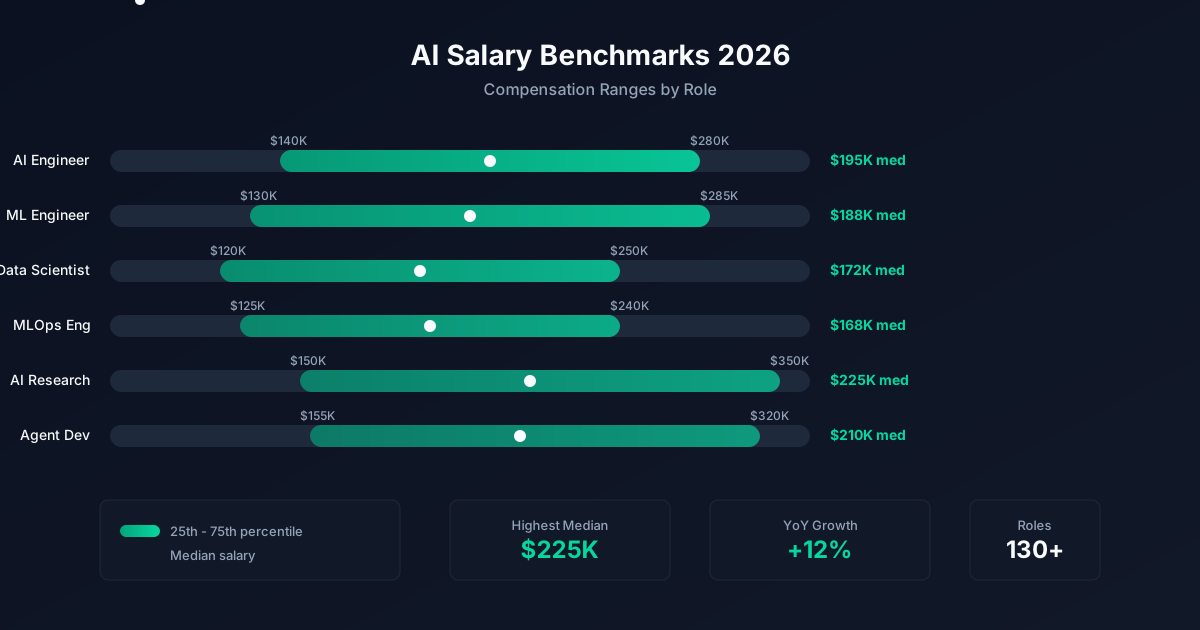
The average maximum salary across all AI roles is $220,203, with a median of $210,325. However, compensation varies significantly by role type, location, and experience level. Prompt Engineers and LLM Engineers command premium salaries as demand outpaces supply, while ML Engineers and Data Scientists remain the volume leaders in job postings.
How We Collect Salary Data
We aggregate salary information exclusively from job postings with disclosed compensation ranges. This includes listings from Indeed, LinkedIn, company career pages, and Greenhouse/Lever job boards. We filter out outliers and normalize data to annual USD equivalents. Our data is updated weekly to reflect current market conditions.
What Affects AI Salaries
Three factors dominate AI compensation: location (San Francisco and New York lead, but remote salaries are increasingly competitive), specialization (LLM and prompt engineering command 15-25% premiums over general ML roles), and company stage (early-stage startups often offer equity-heavy packages while FAANG-tier companies lead in base salary). Browse our breakdowns below to find benchmarks relevant to your situation.
By Role
Compare AI Roles
Side-by-side pay, demand, and skill benchmarks
AI/ML Engineer
View salary data
Prompt Engineer
View salary data
LLM Engineer
View salary data
MLOps Engineer
View salary data
Research Engineer
View salary data
AI Agent Developer
View salary data
AI Product Manager
View salary data
Data Scientist
View salary data
By Location
San Francisco
View salary data
New York
View salary data
Seattle
View salary data
Austin
View salary data
Boston
View salary data
Los Angeles
View salary data
Remote
View salary data
By Experience
By Role & Location
Drill down into salary data for specific role and city combinations.
AI/ML Engineer in SF
Bay Area ML salaries
AI/ML Engineer in NYC
New York ML salaries
Remote AI/ML Engineer
Remote ML salaries
Remote Prompt Engineer
Remote prompt eng salaries
LLM Engineer in SF
Bay Area LLM salaries
Data Scientist in NYC
New York DS salaries
By Role & Level
See how experience level affects compensation for each role.
Senior AI/ML Engineer
Senior-level salaries
Entry-Level AI/ML Engineer
Junior salaries
Senior Data Scientist
Senior DS salaries
Senior Prompt Engineer
Senior PE salaries
Senior LLM Engineer
Senior LLM salaries
Senior MLOps Engineer
Senior MLOps salaries
Using Salary Data for Negotiations
When negotiating an AI role, come prepared with specific data points. Know the salary range for your exact role title, target location, and experience level. Our data shows that candidates who cite specific market benchmarks typically negotiate 10-15% higher offers than those who don't. Remember that total compensation includes base salary, equity, bonuses, and benefits. Our benchmarks focus on base salary ranges as disclosed in job postings.
2026 AI Salary Trends
The AI job market is maturing. While 2023-2024 saw explosive growth in LLM-related roles, 2026 shows more stabilization with continued strong demand for production-focused skills. MLOps and AI infrastructure roles are seeing the fastest salary growth as companies move from experimentation to deployment. Remote work remains prevalent, with remote-first companies often matching or exceeding on-site salaries to compete for talent.
Get Weekly AI Career Intelligence
Salary data, skills demand, and market signals from 16,000+ AI job postings. Every Monday.
About This Role
This role sits at the intersection of AI and engineering, building systems that bring machine learning capabilities into production environments. The scope varies by company, but the common thread is applying AI technology to solve real business problems at scale. Most AI roles today require a combination of software engineering fundamentals and domain-specific ML knowledge, with the exact mix depending on the team's maturity and the product they're building.
The AI job market is evolving fast. New role categories emerge as companies figure out what they need to ship AI-powered products. What matters most is the ability to learn quickly, build working systems, and iterate based on real-world performance data. The specific title matters less than the skills you bring and the problems you can solve. Companies are past the experimentation phase and want engineers who can deliver production-quality systems that work reliably at scale.
We're tracking 4,317 open AI roles right now.
AI hiring keeps growing across industries. Companies in tech, finance, healthcare, and retail are all building AI teams. The strongest demand is for people who can bridge the gap between AI research and production engineering. The shift toward generative AI has created new role types (LLM Engineer, Prompt Engineer, AI Agent Developer) that didn't exist three years ago, while traditional roles (Data Scientist, ML Engineer) have evolved to incorporate LLM capabilities.
AI Hiring Overview
The AI job market has 4,317 open positions tracked in our dataset. By seniority: 138 entry-level, 2,071 mid-level, 1,655 senior, and 453 leadership roles (Director, VP, C-Level). Remote roles make up 15% of the market (635 positions). The remaining 3,657 roles require on-site or hybrid attendance.
The market median for AI roles is $215,000. Top-quartile compensation starts at $266,300. The 90th percentile reaches $320,790. Highest-paying categories: AI Safety ($287,500 median, 34 roles); Research Engineer ($272,100 median, 227 roles); AI Engineering Manager ($244,000 median, 23 roles).
Career Path
Common paths into roles include Software Engineer, Data Scientist, Data Analyst.
From here, career progression typically leads toward Senior Engineer, AI Architect, Engineering Manager, Principal Engineer.
Focus on building things that work. A deployed project that solves a real problem is worth more than any certification. Contribute to open-source, build portfolio projects, and invest in fundamentals (software engineering, statistics, systems design) rather than chasing the latest framework. The AI field moves fast, but the engineers who succeed long-term are the ones with strong fundamentals who can adapt to new tools and paradigms as they emerge.
The AI Job Market Today
The AI job market spans 4,317 open positions across 15 role categories. The largest categories by volume: AI/ML Engineer (3,004), Data Scientist (345), AI Software Engineer (309). These three account for the majority of open positions, though smaller categories often have higher per-role compensation because of specialized skill requirements.
The seniority mix tells a story about where AI teams are in their maturity. Entry-level roles (138) are outnumbered by mid-level (2,071) and senior (1,655) positions, reflecting that most companies are past the 'build a team from scratch' phase and need experienced engineers who can ship production systems. Leadership roles (Director, VP, C-Level) total 453 positions, representing the bottleneck between technical execution and organizational strategy.
Remote work availability sits at 15% of all AI roles (635 positions), with 3,657 requiring on-site or hybrid attendance. The remote share has stabilized after the post-pandemic correction. Senior and specialized roles (Research Scientist, ML Architect) are more likely to be remote-eligible than entry-level positions, partly because experienced hires have more negotiating power and partly because these roles require less hands-on mentorship.
AI compensation is structured in clear tiers. The market median sits at $215,000. Top-quartile roles start at $266,300, and the 90th percentile reaches $320,790. These figures include base salary with disclosed compensation. Total compensation (including equity, bonuses, and sign-on) runs 20-40% higher at companies that offer those components.
Category matters for compensation. AI Safety roles lead at $287,500 median, while Prompt Engineer roles sit at $145,000. The spread between highest and lowest-paying categories reflects the premium on specialized technical skills versus broader analytical roles.
The most in-demand skills across all AI postings: Python (2,249 postings), Aws (1,224 postings), Azure (938 postings), Rag (915 postings), Gcp (660 postings), Pytorch (640 postings), Prompt Engineering (624 postings), Kubernetes (559 postings). Python dominates, appearing in the vast majority of role descriptions regardless of category. Cloud platform experience (AWS, GCP, Azure) is the second most common requirement. The newer entrants to the top skills list (RAG, vector databases, LLM APIs) reflect the shift from traditional ML toward generative AI applications.