Prompt engineering was the breakout AI role of 2023. Job postings exploded. Salaries hit $150K-$300K. People with no engineering background landed six-figure roles by writing clever instructions for ChatGPT.
Two years later, the question everyone in the field is asking: is prompt engineer a stepping stone to AI engineer, or a dead-end specialty?
The answer isn't simple. And the data challenges assumptions on both sides.
The Current State of Prompt Engineering
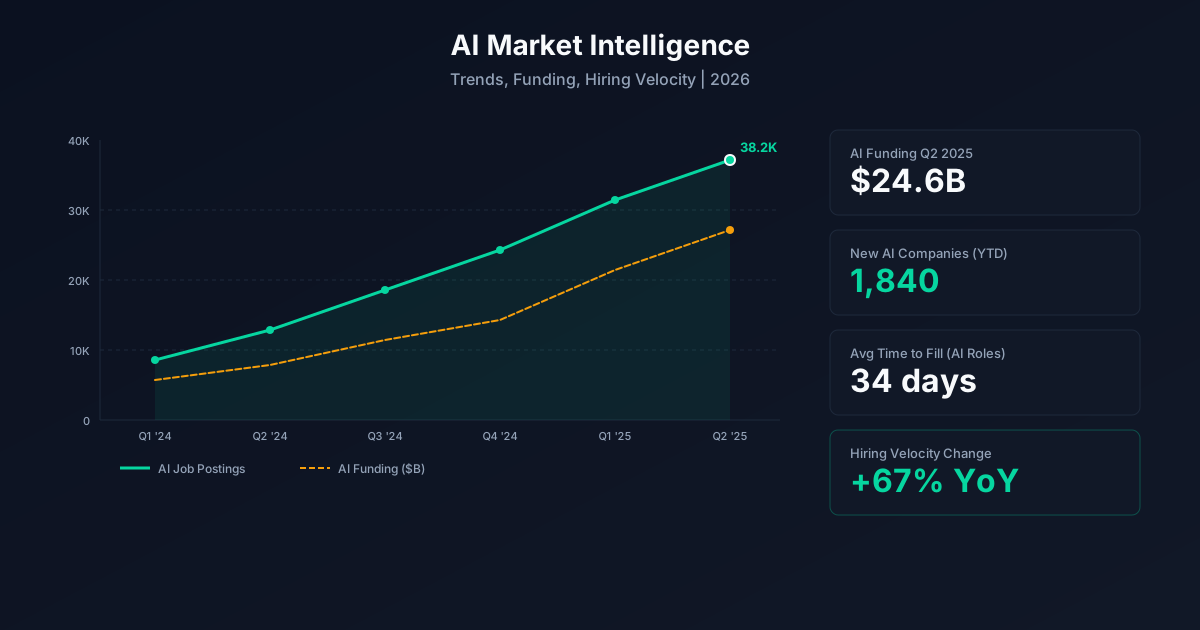
Let's start with what's happening in the market. Prompt engineering job postings peaked in Q3 2024 and have declined 23% since then. That sounds alarming, but context matters.
The decline isn't because prompt engineering skills became irrelevant. It's because those skills got absorbed into other roles. In 2023, "prompt engineer" was a standalone position. In 2026, prompt engineering is a required skill for AI engineers, ML engineers, and increasingly, product managers and designers working on AI products.
Current salary ranges for standalone prompt engineer roles:- Junior (0-2 years): $95K-$130K
- Mid-level (2-4 years): $130K-$180K
- Senior (4+ years): $180K-$250K
- Junior: $120K-$160K
- Mid-level: $160K-$220K
- Senior: $220K-$300K+
Why the Ceiling Exists
Three forces are compressing prompt engineering as a standalone discipline.
1. Model Improvements Reduce Prompt Complexity
GPT-3 required elaborate prompt chains to produce useful output. Claude 3.5 and GPT-4o are dramatically better at following straightforward instructions. The skill gap between a good prompt and a great prompt is narrowing with each model generation.
That doesn't mean prompting is trivial. Complex agentic systems still need careful prompt architecture. But the baseline competence required to get decent results from an LLM has dropped significantly.
2. Tooling Abstracts Away Manual Prompting
Frameworks like LangChain and LlamaIndex include prompt templates and chains that standardize common patterns. What once required a skilled prompt engineer to handcraft can now be pulled from a library.
3. The Role Is Hard to Scope at Senior Levels
Companies struggle to define what a "Staff Prompt Engineer" does that a "Senior AI Engineer" doesn't. When the career ladder gets fuzzy above mid-level, compensation growth stalls and headcount gets harder to justify.
The Bridge: What Transfers
If you're a prompt engineer evaluating the transition to AI engineering, here's the honest assessment of what transfers and what doesn't.
Skills That Transfer Directly
LLM behavior understanding. You know how models think. Where they hallucinate. What retrieval patterns work. What chain-of-thought structures produce reliable output. This intuition takes AI engineers months to develop. You already have it. Evaluation methodology. Good prompt engineers build systematic evaluation frameworks. They measure output quality, consistency, and failure modes. This maps directly to ML evaluation and testing, which is a weak spot for many engineers transitioning into AI. System-level thinking about AI applications. You understand that a single prompt isn't a product. You know about retrieval, context management, output parsing, and error handling. That's closer to AI engineering than most people realize. User intent translation. Translating vague business requirements into specific AI system behavior is valuable everywhere in AI product development.Skills You Need to Build
Software engineering fundamentals. If you came into prompt engineering from a non-technical background, this is the biggest gap. AI engineers write production code. Python proficiency is non-negotiable. Understanding APIs, databases, async programming, and deployment pipelines is expected. RAG architecture. Prompt engineering touches retrieval. AI engineering owns it. You need to understand vector databases, embedding models, chunking strategies, and retrieval evaluation. This is the single most in-demand AI engineering skill in 2026 job postings. Agent frameworks. Building multi-step AI agents that use tools, make decisions, and handle failures is core AI engineering work. The prompting piece is part of it, but the orchestration and error handling are engineering problems. MLOps basics. Model deployment, monitoring, versioning. You don't need to be an MLOps expert, but you need to understand the deployment pipeline well enough to ship code. Testing and CI/CD. Prompt engineers often evaluate manually. AI engineers write automated tests, integrate with CI/CD pipelines, and build regression test suites. The shift from manual to automated evaluation is a major mindset change.The Transition Playbook
Here's a concrete plan based on what worked for people who've successfully made this transition.
Months 1-2: Foundation
Build software engineering muscles. If you're weak on Python, this is where you start. Not a beginner course. Focus on:- Building REST APIs with FastAPI
- Async programming patterns
- Writing unit and integration tests
- Git workflows and code review practices
Months 3-4: Depth
Learn vector databases hands-on. Pick Pinecone, Weaviate, or Chroma. Build something that ingests real data, handles updates, and serves queries with filtered retrieval. Study agent architecture. Build an agent that uses multiple tools, handles failures gracefully, and maintains conversation state. The LangChain and LlamaIndex documentation are starting points, but the goal is understanding the patterns well enough to build without frameworks when needed. Get comfortable with evaluation at scale. Build automated evaluation pipelines that test LLM outputs against ground truth datasets. This is where your prompt engineering evaluation skills evolve into engineering rigor.Months 5-6: Production Readiness
Deploy and monitor something real. Put your RAG application or agent behind a load balancer. Set up logging, monitoring, and alerting. Handle rate limiting and cost tracking. Production experience is what separates AI engineers from people who can build AI demos. Contribute to open source. LangChain, LlamaIndex, and other frameworks have active contributor communities. A few meaningful PRs demonstrate both engineering ability and AI domain knowledge. It's also one of the best networking strategies in the field. Start applying for hybrid roles. Look for "AI Engineer" roles that specifically mention prompt engineering or LLM experience as valued skills. Your prompt engineering background is an advantage for these positions, not a liability.The Numbers: Is the Transition Worth It?
Let's look at the math.
A senior prompt engineer earning $200K transitioning to a mid-level AI engineer role might initially earn $170K-$190K. That's a potential short-term pay cut.
But AI engineer compensation at the senior level reaches $250K-$300K+, with staff-level roles exceeding $350K. The ceiling is substantially higher.
More importantly, AI engineering has clear career progression to principal engineer, engineering manager, or CTO-track roles. Prompt engineering's career ladder is still undefined at most companies.
Then there's market risk. If standalone prompt engineering roles continue declining at 23% annually, the role could be largely absorbed within 2-3 years. AI engineering demand, meanwhile, continues to grow at 31% year-over-year.
The transition cost is 6 months of intense learning. The payoff is a career with a higher ceiling, stronger demand trajectory, and more defined progression.
The Counter-Argument: Specialization Pays
Not everyone should make this transition. There's a compelling case for staying in prompt engineering if:
You're at a company where prompt engineering is a core competency. Companies building AI products where output quality is the differentiator (legal tech, healthcare AI, content platforms) still need dedicated prompt specialists. You've built deep domain expertise. A prompt engineer who deeply understands medical terminology, legal reasoning, or financial analysis is harder to replace than a generalist AI engineer. Domain-specific prompt engineering is more defensible than general-purpose prompting. You prefer breadth over depth. Prompt engineering touches product, design, and business strategy in ways that AI engineering often doesn't. If you enjoy the cross-functional nature of the work, going deeper into engineering might feel like a step in the wrong direction.The Verdict
Prompt engineering isn't a dead end. But it's also not a permanent destination for most people. The skills are real and valuable. The market for standalone roles is contracting. The ceiling is lower than adjacent roles.
For most prompt engineers, the smart move is treating the role as the first 2-3 years of an AI career. Build on the foundation. Learn the engineering side. Make the transition while your LLM expertise is still a differentiator rather than a commodity.
The people who wait until prompt engineering is fully absorbed into other roles will be competing against AI engineers who already have those skills plus everything else. The window to transition from a position of strength is open now. It won't stay open forever.
How AI Pulse data is built
Every number in this article comes from a continuously updated dataset of 10,827 weekly job postings across 42 roles and 14 industries. Salary figures are derived from postings that disclose compensation. AI penetration percentages reflect the share of postings in each function that explicitly require or prefer AI skills. Premium calculations compare median compensation for AI-skilled postings against same-function, same-seniority postings without AI requirements.
Sources & notes. AI Pulse weekly job posting index (n=10,827). Salary disclosure rate: 6.4%. Premium calculations require minimum n=20 postings per role-seniority cell. Updated weekly.
Last updated: 2026-03-29.
How this fits into the bigger career picture
Every article on AI Pulse connects back to the same dataset on AI adoption, salary premiums, and role trajectories. If you're early in your career thinking, the research index covers the full set of insights articles. If you're closer to a job move, the AI by role grid maps the adoption rate and salary premium for every function we track.
The pages that combine the data into a strategic read are the ai-for-* role hubs. Each one synthesizes the adoption story, salary thesis, displacement risk, and the strategic move for that function. If this article is about a specific role, browse the matching hub for the full picture: AI for engineering, marketing, sales, data and analytics, product management, and 19 more.