
The AI job market in 2026 is maturing but still growing. After the explosive demand of 2023-2024 driven by ChatGPT and generative AI, the market has shifted from experimentation to production deployment. Companies are hiring not just for AI research, but for the infrastructure, operations, and product skills needed to ship AI products at scale.
AI Pulse analyzes 4,317 active job postings to surface the signals that matter: which skills are growing, which roles are emerging, and where compensation is heading. Our data comes from Indeed, LinkedIn, Greenhouse, Lever, and direct company career pages, refreshed weekly to reflect current market conditions.
What We Track
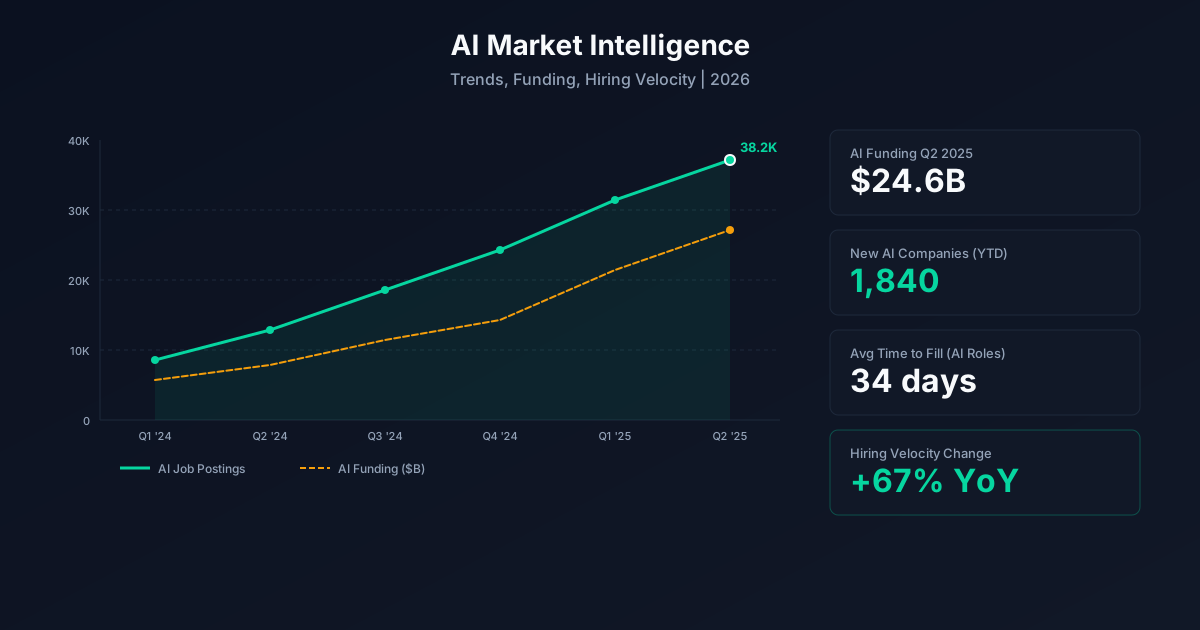
Our market intelligence covers several dimensions: skills and tools (which technologies appear most frequently in job requirements), role distribution (the balance between different AI job categories), work arrangements (remote vs. hybrid vs. on-site), and salary trends (how compensation is moving across roles and locations).
Unlike salary surveys that rely on self-reported data from months ago, our insights come directly from active job postings. This gives you a real-time view of what employers are looking for and willing to pay, not what they were hiring for last quarter.
How Much of the Job Market Now Requires AI
Across 195,452 active postings in every field we track, 16.9% now require AI. Either the role is AI-native or the description calls for AI tools and skills.
43.5% of Engineering jobs now require AI, the most AI-saturated field we track.
Share of jobs requiring AI, by field
Top AI Tools & Frameworks
Most requested technologies in AI/ML job postings.
Job Categories
Distribution of AI roles by category.
Remote Work Distribution
Work arrangement preferences in AI roles.
llm_providers
techniques
languages
Intent_Data
ml_frameworks
infrastructure
Lead_Routing
Integration_iPaaS
CRM_Enterprise
CRM_MidMarket
BI_Analytics
llm_frameworks
vector_databases
Marketing_Automation_Growth
Partner_Channel
Customer_Success
RevOps_Data_Quality
ABM_Platforms
Data_Providers
Chatbots
Product_Analytics
Data_Enrichment
ABM_Signals
Marketing_Automation_Enterprise
Video_Prospecting
Competitive_Intel
Reverse_ETL
Conversational_B2B
Revenue_Intelligence
Sales_Training
Sales_Engagement_Growth
Revenue_Operations
Sales_Enablement_Enterprise
Review_Platforms
Demo_Automation
Proposals
Digital_Sales_Rooms
Gifting_Direct_Mail
PLG_Tools
ABM_Advertising
Visitor_Identification
Meeting_Scheduling
Sales_Compensation
Latest Insights
How AI is Reshaping B2B Sales Roles
AI salary premiums hit 32% across sales roles. GTM Engineer demand up 340% YoY. RevOps teams adopting AI tools at record pace. Here's what the data shows.
AI Engineer Resume Guide: What Hiring Managers Screen For
Hiring managers spend 6 seconds on your resume. ATS systems spend even less. This guide covers the exact structure, keywords, and project descriptions that get AI engineer resumes past both filters and into the interview pile.
Machine Learning Interview Prep: Technical + System Design
ML interviews test three things: coding, ML theory, and system design. Most candidates over-prepare on theory and under-prepare on system design. Here's a structured prep plan with specific problems, timelines, and what interviewers evaluate.
AI Portfolio Projects That Get You Hired
Kaggle notebooks and tutorial clones don't impress hiring managers. Production-quality projects with real deployment, monitoring, and iteration do. Here are the specific project types, architectures, and presentation strategies that land AI engineering offers.
Prompt Engineering Certifications: Which Ones Matter
Over 40 prompt engineering certifications exist in 2026. Most aren't worth the time or money. We reviewed the major options by employer recognition, curriculum quality, and actual career impact to identify which ones move the needle.
AI Consulting Rates 2026: Freelance Benchmarks
AI consultants charge $150-$500/hr depending on specialization and client type. Independent contractors, fractional CTOs, and AI advisory rates across 8 specializations with billing structures and rate negotiation strategies.
Browse by Category
Get Weekly Market Updates
Join our newsletter for AI job market trends, salary insights, and career opportunities.
How to Use This Data
Market intelligence is only valuable if you act on it. Here's how AI professionals use our data: Career planning: identify which skills to develop based on growing demand, not hype. Salary negotiations: use real benchmarks to anchor compensation discussions. Job search strategy: focus on roles and locations where demand exceeds supply.
2026 Market Outlook
Several trends are shaping the AI job market this year. Production over research: Companies that experimented with AI in 2023-2024 are now hiring for deployment and operations. MLOps, platform engineering, and AI infrastructure roles are growing faster than pure research positions. Specialization matters: Generalist "AI Engineer" roles are giving way to specialists like Prompt Engineers, LLM Engineers, ML Infrastructure Engineers, and AI Product Managers with distinct skill requirements.
Remote remains strong: Despite some companies pushing return-to-office, AI roles maintain higher remote availability than the broader tech market. Our data shows remote AI positions often pay within 5-10% of equivalent on-site roles in major metros. The tools stack is consolidating: After a period of framework proliferation, the market is converging on standard stacks. PyTorch for ML, LangChain for LLM orchestration, and cloud-native deployment.
Our Methodology
We aggregate job postings from Indeed, LinkedIn, Greenhouse, Lever, and company career pages. Each posting is enriched with structured data: job category, required skills, experience level, salary range (when disclosed), location, and remote work type. We update our dataset weekly and filter out duplicates, expired postings, and outliers. Our skill extraction uses both keyword matching and semantic analysis to capture tool mentions accurately.