The AI hiring market in 2026 looks nothing like it did two years ago. The hype-driven hiring spree of 2024 burned through billions. Companies that hired 200 AI engineers without a clear product plan have either laid them off or restructured. What's left is more honest: companies hiring for specific problems, with realistic timelines, and actual revenue to fund the work.
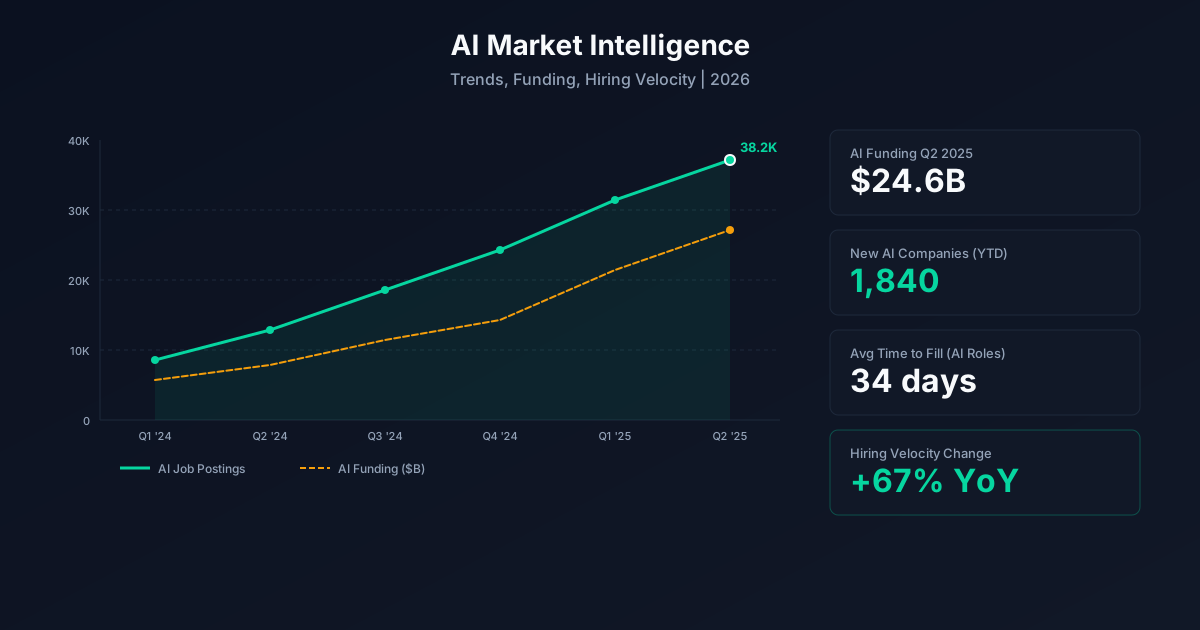
We track active AI job postings across 4,000+ companies. Here's where the best opportunities are right now, ranked not just by volume but by compensation, technical challenge, and career development potential.
Tier 1: The AI Labs
These companies are building foundation models. The technical bar is the highest in the industry, the compensation is the most aggressive, and the work is the most technically ambitious.
OpenAI
Active AI roles: 120+. Compensation range: $300K-$850K total comp for engineering roles. OpenAI remains the most aggressive AI hirer in 2026. They're scaling their infrastructure team heavily after the GPT-5 release, and their applied research team is expanding into enterprise deployment. The interview process is intense (5-6 rounds, including a research presentation), but the equity upside is significant given their latest valuation.
Best roles right now: AI systems engineer, safety researcher, inference optimization engineer.Anthropic
Active AI roles: 80+. Compensation range: $280K-$700K total comp. Anthropic's headcount has grown 45% year-over-year, with the biggest expansion in their safety and alignment teams. Their engineering culture is more research-oriented than OpenAI's, with a stronger emphasis on interpretability work. The company is profitable and growing revenue fast, making the equity component increasingly valuable.
Best roles right now: Research engineer (interpretability), infrastructure engineer, applied AI engineer.Google DeepMind
Active AI roles: 200+. Compensation range: $320K-$1M+ total comp (L5-L7). DeepMind's integration with Google Cloud has created a massive demand for engineers who can bridge research and production. The Gemini team alone has 50+ open positions. DeepMind compensation follows Google's pay bands, which means liquid RSUs and transparent leveling.
Best roles right now: Gemini infrastructure engineer, multimodal research scientist, AI safety researcher.Meta AI (FAIR)
Active AI roles: 150+. Compensation range: $300K-$900K total comp. Meta's commitment to open-source AI (LLaMA) has made their AI division one of the most interesting places to work in the industry. The open-source approach means your work gets used by millions of developers, which is a rare combination of impact and visibility.
Best roles right now: LLaMA optimization engineer, recommendation ML engineer, AR/VR AI researcher.Tier 2: AI-Native Companies
These companies build products powered by AI. The technical challenges are different from the labs (more product-focused, more customer-facing), but the compensation is competitive and the growth potential is high.
Databricks
Active AI roles: 100+. Compensation range: $250K-$650K total comp. Databricks' AI ambitions go beyond their data platform. Their acquisition of MosaicML positioned them as a training infrastructure company, and they're hiring heavily for their model serving and MLOps teams. Pre-IPO equity is a significant draw.
Best roles right now: ML platform engineer, model serving engineer, data intelligence architect.Scale AI
Active AI roles: 60+. Compensation range: $220K-$550K total comp. Scale's data annotation business has evolved into a full AI evaluation and deployment platform. The company works with most of the major AI labs, giving engineers exposure to advanced model development. Compensation is strong for the Bay Area, with meaningful equity given their likely IPO timeline.
Best roles right now: ML engineer (evaluation), data quality engineer, enterprise AI engineer.Cohere
Active AI roles: 40+. Compensation range: $200K-$500K total comp. Cohere focuses on enterprise LLM deployment, which means the engineering challenges are practical: latency optimization, fine-tuning pipelines, retrieval systems. Based in Toronto with remote options, Cohere offers strong compensation without Bay Area cost of living.
Best roles right now: NLP engineer, enterprise solutions architect, inference optimization engineer.Hugging Face
Active AI roles: 35+. Compensation range: $180K-$450K total comp. Hugging Face is the hub of the open-source AI ecosystem. Working there means building infrastructure used by millions of ML practitioners. The culture is remote-first and open-source-oriented, which attracts a specific type of engineer.
Best roles right now: ML engineer (model hub), DevRel engineer, open-source infrastructure engineer.Tier 3: Big Tech AI Divisions
These companies have the resources, the data, and the distribution to build AI at a scale nobody else can match.
Apple
Active AI roles: 180+. Compensation range: $280K-$750K total comp. Apple's AI hiring is the most aggressive it's been in a decade. Their on-device AI strategy requires a fundamentally different approach than cloud-based AI, which makes the technical problems unique. Apple's secrecy means less public visibility for your work, but the compensation and work-life balance are strong.
Best roles right now: On-device ML engineer, Siri NLU engineer, vision ML researcher.Amazon (AWS AI)
Active AI roles: 250+. Compensation range: $250K-$650K total comp. AWS is the infrastructure layer for most of the AI industry. Their Bedrock and SageMaker teams are hiring at every level. The work is infrastructure-heavy and customer-facing, which means you're solving real deployment problems, not research problems. Amazon's compensation has improved significantly to compete for AI talent.
Best roles right now: Bedrock ML engineer, SageMaker platform engineer, AI solutions architect.Microsoft
Active AI roles: 300+. Compensation range: $260K-$700K total comp. Microsoft's AI strategy is the most diversified in Big Tech: Azure AI, Copilot, GitHub Copilot, Bing AI, and their $13B OpenAI partnership. The sheer number of AI surface areas means there's a role for almost every AI specialization. Compensation has increased 15-20% for AI roles over the past year.
Best roles right now: Copilot ML engineer, Azure AI infrastructure, responsible AI researcher.Tier 4: Industry Leaders Deploying AI
These companies aren't AI companies. They're companies where AI is transforming the core business. The compensation is slightly lower, but the impact is often more tangible.
Stripe
Active AI roles: 30+. Compensation range: $250K-$600K total comp. Stripe's AI team focuses on fraud detection, revenue optimization, and automated financial operations. The problems are concrete, the data is massive, and the impact is measured in dollars saved. Engineers who want to see their models directly affect the bottom line thrive here.
Spotify
Active AI roles: 25+. Compensation range: $200K-$500K total comp. Spotify's recommendation system is one of the most sophisticated in the consumer tech space. The ML engineering team works on personalization, audio intelligence, and content understanding. European offices offer strong comp relative to local markets.
Tesla
Active AI roles: 40+. Compensation range: $200K-$550K total comp. Tesla's AI work spans autonomous driving, robotics (Optimus), and energy optimization. The technical challenges in real-time computer vision and reinforcement learning are among the most interesting in the industry. Work-life balance concerns are real, but the technical problems are unmatched.
How to Evaluate an AI Employer
Beyond the company name and compensation, here's what to assess:
Technical Signal
- What's the model-to-product ratio? Companies where AI is the product (labs, AI-native) offer more pure AI work. Companies where AI supports the product offer more integration work.
- What's the team size and structure? Small teams (under 20) mean more ownership. Large teams (100+) mean more specialization.
- What's the tech stack? Companies still running on legacy ML infrastructure (Spark MLlib, custom C++ serving) will feel different from those using modern tools (Ray, vLLM, LangChain).
Career Signal
- What's the promotion cadence? Big Tech has defined cycles. Startups promote on impact.
- Where do alumni go? Check LinkedIn for where former AI engineers at this company ended up. If they're all still at the same level elsewhere, that's a signal.
- What's the publishing culture? Companies that publish papers and open-source tools build your external reputation. Companies that don't keep your work invisible.
Financial Signal
- Revenue trajectory. A company growing revenue 50%+ year-over-year can sustain AI investment. A company burning cash on AI with no revenue path can't.
- Equity structure. RSUs at public companies are cash-equivalent. Options at pre-IPO companies are speculative. ISOs vs. NSOs matter for tax purposes.
- Funding runway. For private companies, less than 18 months of runway is a yellow flag. Less than 12 is a red flag.
The Market in 2026
The AI hiring market has matured. The "hire first, figure out the product later" phase is over. Companies hiring AI engineers today have specific technical problems, real customers, and defined success metrics.
That's good news for candidates. The roles are more substantive, the expectations are clearer, and the companies are more likely to still exist in two years. The spray-and-pray application strategy doesn't work anymore. Targeted applications to companies whose problems match your skills will outperform volume every time.
The best AI engineering roles aren't posted on LinkedIn. They're filled through referrals, open-source contributions, and technical communities. Build in public. Contribute to the projects these companies depend on. The best job application is a merged pull request.
How AI Pulse data is built
Every number in this article comes from a continuously updated dataset of 10,827 weekly job postings across 42 roles and 14 industries. Salary figures are derived from postings that disclose compensation. AI penetration percentages reflect the share of postings in each function that explicitly require or prefer AI skills. Premium calculations compare median compensation for AI-skilled postings against same-function, same-seniority postings without AI requirements.
Sources & notes. AI Pulse weekly job posting index (n=10,827). Salary disclosure rate: 6.4%. Premium calculations require minimum n=20 postings per role-seniority cell. Updated weekly.
Last updated: 2026-03-29.
How this fits into the bigger career picture
Every article on AI Pulse connects back to the same dataset on AI adoption, salary premiums, and role trajectories. If you're early in your career thinking, the research index covers the full set of insights articles. If you're closer to a job move, the AI by role grid maps the adoption rate and salary premium for every function we track.
The pages that combine the data into a strategic read are the ai-for-* role hubs. Each one synthesizes the adoption story, salary thesis, displacement risk, and the strategic move for that function. If this article is about a specific role, browse the matching hub for the full picture: AI for engineering, marketing, sales, data and analytics, product management, and 19 more.