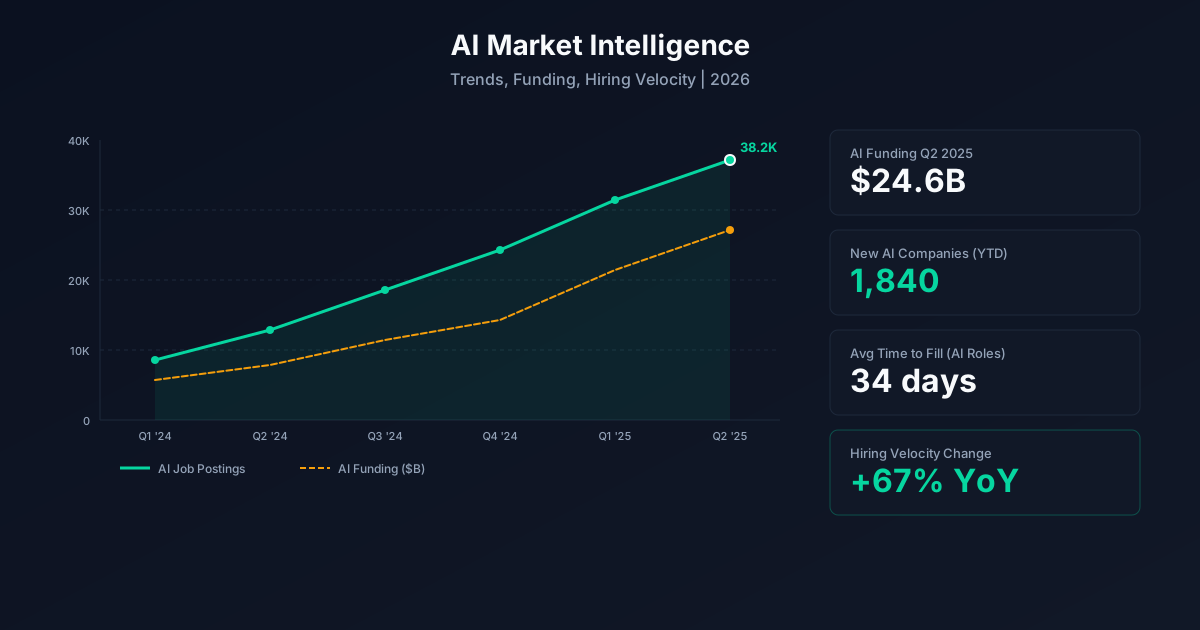
AI product. NIST AI standards inform the compliance requirements AI PMs must build into their product roadmaps. AI product management didn't exist as a distinct role five years ago. Today, it's one of the fastest-growing positions in tech, with job postings up 42% year-over-year and compensation that rivals engineering roles at the senior level. The demand makes sense: companies are shipping AI products at record pace, and they need people who can bridge the gap between what AI can do and what users need.
Here's what the role looks like in 2026, how to break in, and what you'll earn.
What AI Product Managers Do
An AI product manager. The BLS IT management outlook covers the broader management career path that AI PMs fall under. Product manager owns the strategy, roadmap, and execution for AI-powered products or features. The work is similar to traditional product management but with unique challenges that make it a distinct specialty.
Daily Responsibilities
- Defining product requirements for AI features (what the model should do, how to measure success)
- Collaborating with ML engineers and data scientists on model capabilities and limitations
- Setting evaluation criteria for AI outputs (accuracy thresholds, safety requirements, latency budgets)
- Managing user feedback loops for AI products (users interact with AI differently than with traditional software)
- Prioritizing the product roadmap based on technical feasibility and business impact
- Communicating AI capabilities and limitations to executives and stakeholders
- Monitoring AI product metrics (not just engagement, but output quality, user trust, and safety)
What Makes It Different from Regular PM Work
Three things set AI product management apart from traditional product management.
First, uncertainty is higher. Traditional software is deterministic: the button does what you coded it to do. AI products are probabilistic: the model produces different outputs for similar inputs, and you can't fully predict what it will say or do. AI PMs need to design for uncertainty rather than certainty.
Second, the feedback loop is different. Traditional PMs measure success with clicks, conversions, and retention. AI PMs also need to measure output quality, which requires evaluation frameworks that don't always have clear metrics. "Is this response good?" is harder to measure than "did the user click the button?"
Third, the stakeholder dynamic is more complex. You're translating between ML engineers (who think in model performance metrics), executives (who think in revenue), and users (who think in terms of "does this work for me?"). Each group has a different language for describing the same product.
Salary Benchmarks
AI product managers earn a premium over traditional PMs, and the gap is growing.
AI Product Manager Compensation (2026)
- Associate AI PM (0-2 years): $110K-$145K base. Total comp: $130K-$180K
- AI Product Manager (3-5 years): $145K-$190K base. Total comp: $190K-$300K
- Senior AI PM (5-8 years): $190K-$250K base. Total comp: $300K-$480K
- Director of AI Product (8+ years): $240K-$320K base. Total comp: $420K-$700K
- VP of AI Product (12+ years): $280K-$380K base. Total comp: $550K-$1M+
Compared to Traditional PM Compensation
AI PMs earn 15-25% more than traditional PMs at the same seniority level. The premium reflects the specialized knowledge required and the scarcity of people who can operate effectively at the intersection of product strategy and AI technology.
At the director level and above, the gap widens further. Director of AI Product roles pay $420K-$700K total comp, while traditional Director of Product roles pay $350K-$550K. Companies building AI-first products need senior product leaders who understand the technology deeply enough to make strategic bets.
Top-Paying Companies for AI PMs
Google, Meta, Apple, and Microsoft lead in total compensation. OpenAI and Anthropic pay competitively but with smaller equity packages (offset by growth potential). Databricks, Scale AI, and other AI-native companies offer strong base salaries with significant equity upside.
How to Break into AI Product Management
Path 1: Traditional PM to AI PM
The most common transition. If you're already a PM, you need to build AI-specific knowledge without going back to school. Focus areas:
- LLM fundamentals: Understand how large language models work at a conceptual level. You don't need to train models, but you need to understand context windows, temperature, token limits, hallucination, and prompt engineering well enough to make product decisions.
- Evaluation methodology: Learn how to measure AI output quality. Understand precision, recall, BLEU scores, human evaluation protocols, and A/B testing for AI features.
- AI product patterns: Study how successful AI products work. Examine how ChatGPT, GitHub Copilot, Notion AI, and Perplexity make product decisions around AI uncertainty.
Path 2: ML Engineer to AI PM
Less common but highly valued. You bring technical credibility that other AI PMs lack. The gaps to fill:
- Product strategy and business thinking
- Stakeholder management and communication
- User research and customer empathy
- Roadmap prioritization frameworks
Path 3: Data Scientist to AI PM
A natural transition for data scientists who enjoy the business side more than the modeling side. You already understand data, metrics, and experimentation. The gaps:
- Product management fundamentals (roadmapping, stakeholder management, sprint planning)
- Software development lifecycle understanding
- Design thinking and user experience
Path 4: Direct Entry (MBA or New Grad)
Some companies hire AI PMs directly out of MBA programs or as new graduates. These roles typically have "Associate" in the title and require demonstrated interest in AI (coursework, projects, or previous industry experience). Top MBA programs with strong AI PM placement: Stanford GSB, Wharton, MIT Sloan, and Harvard Business School.
Critical Skills for 2026
Technical Knowledge (Must-Have)
- Understanding of LLM capabilities, limitations, and architecture at a product level
- Prompt engineering (enough to prototype and evaluate, not build production systems)
- AI evaluation methodology (automated and human evaluation frameworks)
- Basic statistics and A/B testing methodology
- Understanding of RAG, agents, and fine-tuning at a conceptual level
Product Skills (Must-Have)
- Roadmap prioritization under uncertainty
- User research for AI products (understanding how users develop trust/distrust in AI)
- Defining success metrics for probabilistic systems
- Managing stakeholder expectations when AI capabilities are uncertain
- Competitive analysis of AI products
Emerging Skills (Differentiators)
- AI safety and responsible AI product practices
- Regulatory awareness (EU AI Act, emerging US regulations)
- AI cost optimization (understanding compute costs well enough to make build/buy/API decisions)
- Multi-model product strategy (when to use GPT-4 vs Claude vs open-source vs fine-tuned)
Job Market in 2026
AI PM postings grew 42% year-over-year, making it the fastest-growing PM specialty. The largest concentrations of openings are at Big Tech companies (Google, Microsoft, Meta, Apple, Amazon), AI-native companies (OpenAI, Anthropic, Cohere, Databricks), and enterprise companies building AI features into existing products (Salesforce, Adobe, Intuit).
Remote availability is approximately 38% of AI PM postings, slightly below the overall tech PM average of 42%. Companies prefer AI PMs to be co-located with their engineering teams, particularly during early-stage product development.
Interview Process
Expect 4-6 rounds: a recruiter screen, a product sense round (how would you design an AI feature?), a technical assessment (can you discuss AI concepts fluently?), a metrics/analytics round, an execution round (tell me about a time you shipped something complex), and a leadership/culture round. The technical bar is higher than for traditional PM roles but lower than for engineering roles.
Career Trajectory
The AI PM career path is still forming. Here's what it looks like today:
Years 1-3: Associate or IC AI PM. Own a feature area. Ship AI products with guidance from senior PMs and eng leads. Years 3-5: AI PM or Senior AI PM. Own a product area. Define strategy, manage a team of engineers, and drive business outcomes. Years 5-8: Senior AI PM or Director. Own multiple product areas or a product line. Hire and manage other PMs. Report to VP or C-level. Years 8-12: Director or VP of AI Product. Set product strategy for the AI organization. Own P&L. Build the product team. Years 12+: VP, SVP, or CPO. Product leadership at the company level. Several current Chief Product Officers at AI companies came from AI PM backgrounds.The Case for This Career
AI product management is one of the best career bets in tech for 2026 and beyond. The demand is growing faster than supply. The compensation is competitive with engineering. The work is intellectually stimulating and high-impact.
The risk: if AI products become simple enough to not need specialized PMs, the role could merge back into general product management. That's possible in the long term (5-10 years), but unlikely in the near term. AI products are getting more complex, not simpler. Multi-model architectures, agent systems, and regulatory requirements are adding layers of product complexity that generalist PMs aren't equipped to handle.
The floor is high, the ceiling is rising, and the demand isn't slowing down. If you're interested in the intersection of technology and product strategy, AI product management is worth a serious look.
Breaking In: Transition Playbooks
From Traditional Product Management
This is the most common path into AI PM. You already have product skills. The gap is AI-specific knowledge.
Month 1-2: Build technical foundations. Take a short course on LLM fundamentals (DeepLearning.AI's courses are good starting points). Learn enough Python to prototype basic LLM applications. Understand the difference between RAG, fine-tuning, and prompting at a conceptual level. Month 2-3: Apply AI thinking to your current work. Find an AI opportunity in your current product. Propose and lead a small AI feature, even if it's a prototype. Document what you learn about AI product challenges. Month 3-4: Build your AI PM portfolio. Write a product spec for an AI feature that demonstrates your understanding of probabilistic outputs, evaluation methodology, and AI-specific UX considerations. Practice articulating AI product trade-offs in conversations with engineers.From ML Engineering
Engineers transitioning to AI PM bring deep technical credibility. The gaps are product strategy, user research, and business communication.
Month 1-2: Study product management fundamentals. Read "Inspired" by Marty Cagan. Practice writing product specs and prioritization frameworks. Learn how to structure user research. Month 2-3: Start thinking in business terms. How does your current engineering work translate to revenue? What are the user needs behind the technical requirements you receive? Practice communicating technical decisions in business language. Month 3-4: Seek PM responsibilities within your current role. Define requirements for a feature. Conduct a user research session. Present a product strategy recommendation to leadership. These experiences build your PM portfolio.From Data Science
Data scientists bring statistical thinking and analytical skills. The gaps are similar to engineers but with an additional need for product intuition and stakeholder management.
Focus your transition on the product side: user research, prioritization frameworks, and cross-functional communication. Your data skills give you a unique advantage in defining AI product metrics, which is one of the hardest parts of the job.
AI PM Tools and Frameworks
Evaluation Frameworks
AI PMs need structured approaches to evaluating AI product quality:
- Accuracy/Relevance scoring: Define rubrics for output quality on a 1-5 scale. Have evaluators rate random samples.
- Side-by-side comparison: Show evaluators two outputs (from different models or versions) and have them choose the better one.
- Red teaming: Systematically test for failure modes, edge cases, and harmful outputs before launch.
- A/B testing: Deploy two versions and measure user behavior metrics (task completion, satisfaction, usage frequency).
Cost Modeling
Every AI PM decision has cost implications. Understand:
- Cost per query for different model tiers (GPT-4o vs GPT-4o-mini vs open-source)
- Infrastructure costs for self-hosted vs API-based approaches
- The cost of evaluation and monitoring at scale
- How costs scale with user growth
User Trust Calibration
AI products succeed or fail based on user trust. Too much trust leads to dangerous over-reliance. Too little trust means the product goes unused.
Design patterns that calibrate trust:
- Show confidence indicators when the model is less certain
- Make it easy to verify AI outputs against original sources
- Be transparent about limitations ("I'm not sure about this")
- Provide feedback mechanisms so users can flag errors
- Gradually expand AI capabilities as users develop appropriate mental models
How AI Pulse data is built
Every number in this article comes from a continuously updated dataset of 10,827 weekly job postings across 42 roles and 14 industries. Salary figures are derived from postings that disclose compensation. AI penetration percentages reflect the share of postings in each function that explicitly require or prefer AI skills. Premium calculations compare median compensation for AI-skilled postings against same-function, same-seniority postings without AI requirements.
Sources & notes. AI Pulse weekly job posting index (n=10,827). Salary disclosure rate: 6.4%. Premium calculations require minimum n=20 postings per role-seniority cell. Updated weekly.
Last updated: 2026-03-29.
How this fits into the bigger career picture
Every article on AI Pulse connects back to the same dataset on AI adoption, salary premiums, and role trajectories. If you're early in your career thinking, the research index covers the full set of insights articles. If you're closer to a job move, the AI by role grid maps the adoption rate and salary premium for every function we track.
The pages that combine the data into a strategic read are the ai-for-* role hubs. Each one synthesizes the adoption story, salary thesis, displacement risk, and the strategic move for that function. If this article is about a specific role, browse the matching hub for the full picture: AI for engineering, marketing, sales, data and analytics, product management, and 19 more.