
LLM Engineer vs MLOps Engineer
Head-to-head comparison of salary, required skills, and career outlook for two of the most in-demand AI roles.
Quick Verdict
Choose MLOps Engineer if you want higher compensation. It pays 41% more on average. Choose MLOps Engineer if you want more open positions (164 vs 29 currently listed). LLM Engineer focuses on building LLM-powered applications and infrastructure, while MLOps Engineer centers on deploying and maintaining ML systems in production.
Side-by-Side Comparison
| Dimension | LLM Engineer | MLOps Engineer |
|---|---|---|
| Open Positions | 29 | 164 |
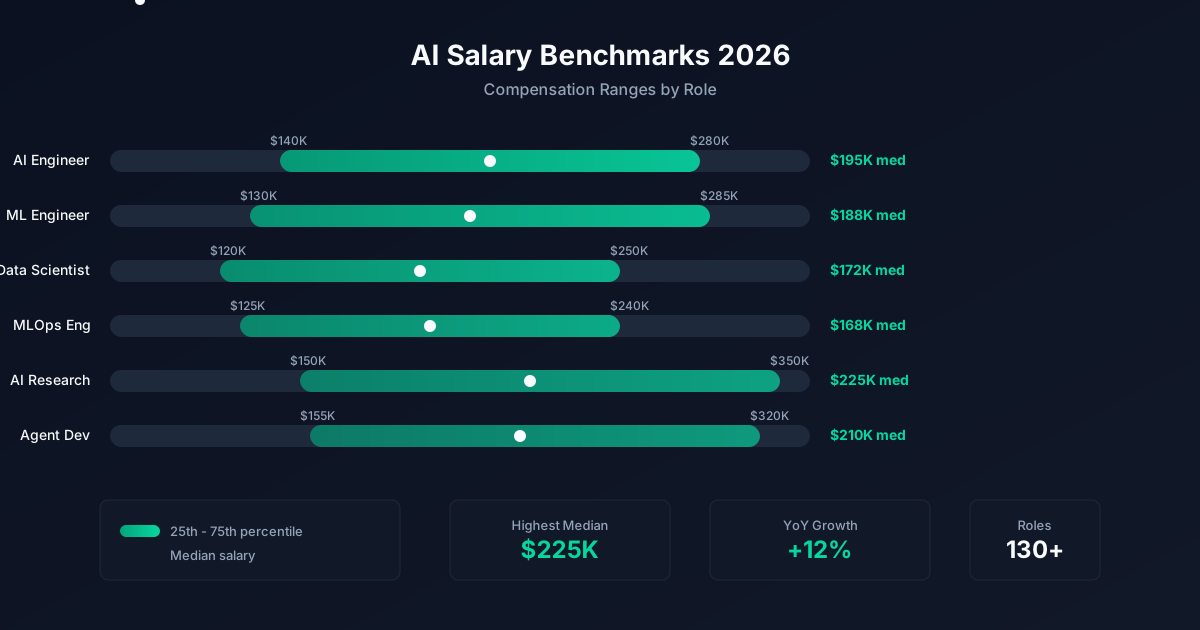
| Avg Salary Range | $116K–$143K | $132K–$203K |
| Median Salary | $142K | $207K |
| 75th Percentile | $152K | $230K |
| Remote % | 10% | 5% |
| Experience Mix | Senior 21%, Mid 79% | Senior 46%, Mid 54%, Entry 1% |
| Top Skill | Python | Python |
Skills Comparison
LLM Engineer Top Skills
PythonPytorchPrompt EngineeringRagEmbeddingsTensorflowAwsHugging FaceMLOps Engineer Top Skills
PythonKubernetesMlflowAwsDockerAzureRagLangchainSkills You'd Need for Both Roles
These skills appear in top-8 for both LLM Engineer and MLOps Engineer: Aws, Python, Rag. If you have these skills, you're well-positioned for either path.
Salary Deep Dive
Top Hiring Companies
LLM Engineer
MLOps Engineer
Career Path
LLM Engineer Career Path
Typical progression: Senior LLM Engineer, AI Architect, Head of AI. Focuses on building LLM-powered applications and infrastructure.
MLOps Engineer Career Path
Typical progression: Senior MLOps Engineer, ML Platform Lead, VP of Infrastructure. Focuses on deploying and maintaining ML systems in production.
Switching Between Roles
With 3 overlapping skills (37% of top skills), transitioning between these roles is feasible with targeted upskilling.
LLM Engineer vs MLOps Engineer: What You Need to Know
LLM Engineer and MLOps Engineer are two of the most searched AI career paths right now, and for good reason. Both offer strong compensation, high demand, and clear growth trajectories. But they're different jobs that attract different skill sets and personalities.
Across the 11,520 open AI positions we track, LLM Engineer makes up 0% of listings while MLOps Engineer accounts for 1%. Those numbers shift weekly, but the relative demand has been consistent.
This comparison breaks down the salary data, required skills, hiring patterns, and career trajectories for both roles so you can make an informed decision.
Skills Analysis: Where the Roles Diverge
LLM Engineer skills: RAG and vector databases are the most common requirements. Expect to work with LangChain or LlamaIndex, embedding models, and at least one vector store (Pinecone, Weaviate, Chroma). Python is non-negotiable. Understanding the cost/latency/quality tradeoffs between different model providers and architectures is what separates senior from junior engineers.
MLOps Engineer skills: Kubernetes, Docker, and cloud infrastructure are baseline. Most roles want experience with ML-specific tooling: MLflow, Kubeflow, Weights & Biases, or similar. Strong DevOps fundamentals matter more than ML theory. You need to understand model serving (TorchServe, Triton, vLLM), monitoring (Prometheus, Grafana), and infrastructure-as-code (Terraform, Pulumi).
Both roles share demand for Aws, Python, Rag. That overlap means professionals can build a foundation that keeps both paths open.
Skills unique to LLM Engineer postings include Pytorch, Prompt Engineering, Embeddings, Tensorflow. These reflect the role's emphasis on its core domain.
For MLOps Engineer, differentiating skills include Kubernetes, Mlflow, Docker, Azure. These align with the role's focus on its core domain.
Fine-tuning experience is valuable for specific use cases but most production LLM work is RAG-based. Agent frameworks (LangGraph, CrewAI, custom orchestration) are increasingly important as companies move beyond simple chat interfaces. Evaluation and observability tools (LangSmith, Arize, custom dashboards) are essential for production deployments.
GPU infrastructure knowledge is increasingly valuable as LLM inference becomes a major cost center. Understanding GPU scheduling, multi-node training setups, and inference optimization (quantization, batching, caching) puts you in the top tier. Experience with model registries and feature stores rounds out the profile.
Salary Breakdown: Beyond the Averages
MLOps Engineer commands a $59K higher average salary ceiling than LLM Engineer. That gap reflects differences in required experience, scarcity of talent, and the complexity of the work.
Median salaries tell a more grounded story. LLM Engineer sits at $142K while MLOps Engineer comes in at $207K. The median filters out outlier offers from top-tier companies that can skew averages.
At the 75th percentile, LLM Engineer reaches $152K and MLOps Engineer reaches $230K. These numbers represent what experienced professionals at well-funded companies can expect.
Remote work availability differs: 10% of LLM Engineer roles are fully remote vs 5% for MLOps Engineer. Remote roles sometimes adjust compensation based on location, which can affect the salary range you see in practice.
Career Trajectories Compared
Getting into LLM Engineer: The fastest path is through software engineering. If you can build production systems and you understand LLM capabilities and limitations, you're already qualified for most roles. Build a portfolio project that demonstrates RAG implementation, evaluation, and cost optimization. Open-source contributions to LLM frameworks are strong signals to hiring managers.
Getting into MLOps Engineer: DevOps engineers with ML curiosity have the shortest path. You already understand deployment, monitoring, and infrastructure. Add ML-specific knowledge (model serving, data pipelines, experiment tracking) and you're competitive. The career ceiling is high: ML Platform Lead roles at top companies pay well because the infrastructure complexity is enormous.
Both roles commonly draw from the same talent pools: Data Engineer. If you're coming from one of those backgrounds, you have a real choice between these two paths.
LLM Engineer typically leads to roles like AI Architect, Principal Engineer, AI Engineering Manager. MLOps Engineer progression tends toward ML Platform Lead, Infrastructure Architect, Engineering Manager.
Industry Demand and Hiring Patterns
LLM Engineer market: LLM Engineer is one of the fastest-growing AI job titles. Every company building AI-powered products needs people who understand the full stack: from embedding models to vector stores to inference optimization. The supply of experienced LLM engineers is thin because the field is so new, which keeps compensation high and demand strong.
MLOps Engineer market: MLOps demand tracks closely with production ML adoption. As more companies move models from notebooks to production, the need for MLOps grows. The role is well-established at large tech companies and growing fast at mid-stage startups that are hitting the 'our models work in notebooks but break in production' phase.
What to look for in LLM Engineer postings: Look for roles that specify the production stack, mention specific use cases, and talk about cost optimization. Companies that understand LLM engineering will mention evaluation methodology, latency requirements, and scale targets. Vague 'build AI features' postings often mean they haven't figured out their architecture yet.
What to look for in MLOps Engineer postings: Good MLOps postings specify their ML stack, infrastructure scale, and the problems they're solving (deployment velocity, cost optimization, monitoring gaps). Red flag: companies that want MLOps but don't have any models in production yet. You'll end up doing general DevOps instead.
Seniority distribution matters for career planning. LLM Engineer skews 21% senior and 0% entry-level. MLOps Engineer is 46% senior and 1% entry-level. Both roles lean experienced, so building relevant skills before applying is important.
Top hiring metros for LLM Engineer: Los Angeles, Remote, San Francisco. For MLOps Engineer: Los Angeles, San Francisco, New York. The Bay Area and New York dominate both, but remote hiring is reshaping geographic concentration.
Day-to-Day: What the Work Looks Like
A week as a LLM Engineer: A typical week includes: building and testing RAG pipelines (chunking strategies, embedding models, retrieval evaluation), debugging why the agent took a wrong action path, optimizing inference costs (caching, batching, model selection), and working with the product team on new LLM-powered features. You'll context-switch between deep technical work and cross-functional collaboration.
A week as a MLOps Engineer: A typical week involves: debugging a model deployment that's serving stale predictions, building a new monitoring dashboard for a feature team, writing Terraform for GPU-enabled inference clusters, reviewing pull requests for the ML platform's CI/CD pipeline, and meeting with data scientists to understand their pain points. You're the bridge between ML and infrastructure.
LLM Engineer vs MLOps Engineer FAQ
Related Comparisons
Track AI Salary Trends
Get weekly salary data and career intelligence for AI professionals.