
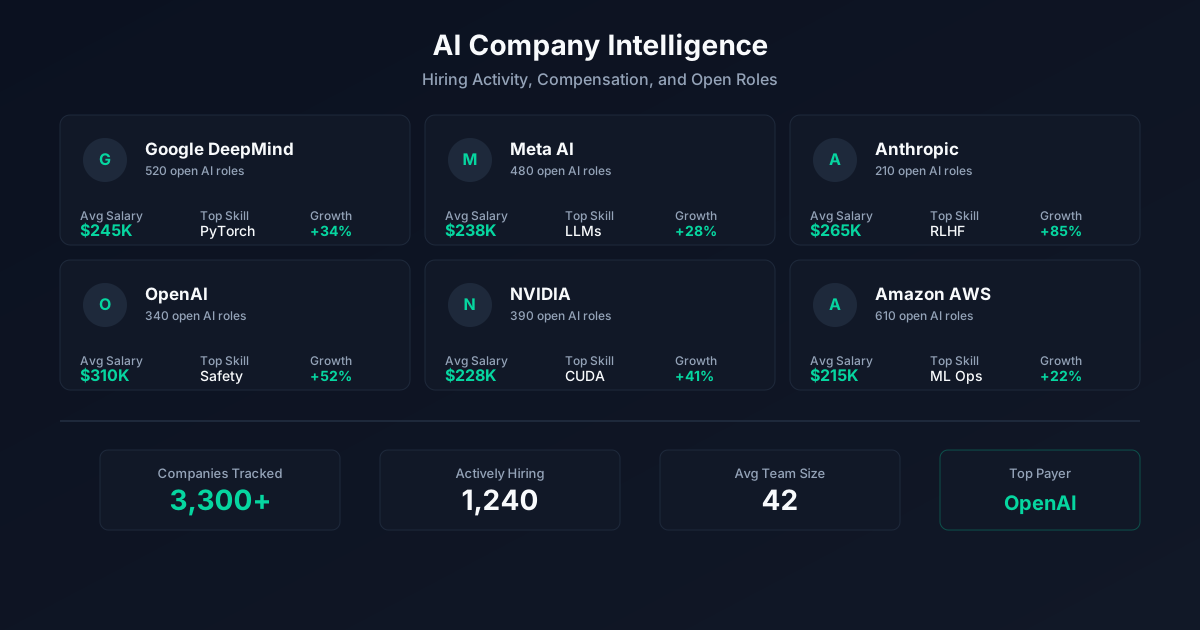
Meta is actively hiring for 67 AI and machine learning positions across AI/ML Engineer (38), Research Scientist (14), and Research Engineer (8) roles. Posted salary ranges span $170K - $347K, with 70% of listings disclosing compensation. The median posted ceiling sits at $250K. Positions are based in New York, NY, Menlo Park, CA, US, New York, NY, US. The most frequently requested skills across these postings are Python, Pytorch, Tensorflow, Rust, Javascript. Mid-level roles account for 91% of openings.
Skills & Technologies
Locations
New York, NY, Menlo Park, CA, US, New York, NY, US, Bellevue, WA, US, Burlingame, CA, US
Hiring by Role Category
Open Positions (showing 25 of 67)
Product Marketing Lead, Social and AI, Facebook
Engineering Manager, Machine Learning
Associate General Counsel, AI Product
Software Engineering Manager, AI for Wearables and Health.
Research Scientist, Machine Learning
AI Research Scientist, MRS Knowledge
GBG Sales Intelligence Lead, AI Go-To-Market
Public Affairs AI Communications Manager
Research Scientist, AI Language
Communications Manager, AI Products
Software Engineer, Systems ML - Compilers / Kernels
Product Marketing Manager, Generative AI
Production Systems Engineer, Fleet AI Systems
Software Engineer, Machine Learning - Central Integrity
Research Scientist, Clinical AI Evaluation Lead
Research Scientist, Wearables AI
Research Engineer, Language - Wearables Voice AI
Enterprise AI Technical Product Marketing Manager
Research Engineer, FAIR SGT - Paris
Product Policy Manager, GenAI
AI Research Scientist (Technical Leadership)
Software Engineer, GenAI Frameworks - MTIA
Software Engineer, Systems Machine Learning
What Meta's hiring tells you
With 67 active AI roles spanning 6 role types, hiring at this scale signals AI is core to the business model, not a pilot. Companies in this tier typically have a named AI leader (VP AI, Head of ML), dedicated infrastructure budget, and a multi-year roadmap. Posted compensation range ($170K - $347K) suggests transparent and competitive pay practices.
The skill mix here leans toward Python in AI/ML Engineer roles. That is a clue about what Meta is building: teams hire for the work in front of them, not the work they wish they were doing.
Questions worth asking in the Meta interview loop
The signals above come from public job postings. The signals you actually need come from the conversation. A few questions calibrated to this company's tier:
- How is the AI org structured, and who does it report to (CTO, CEO, separate AI leader)?
- What was the most recent ML system that shipped to production, and what was the scope?
- How much of compute spend is on inference vs training, and how is that decided?
Meta AI and ML Hiring
Meta has 67 active AI and ML roles in our dataset. Open positions span AI/ML Engineer, AI Software Engineer, Research Scientist, Research Engineer. Compensation ranges from $170K - $347K across disclosed roles. Roles are based in New York, NY, Menlo Park, CA, US, New York, NY, US, Bellevue, WA, US.
Salary Benchmarks
The market median for AI roles is $213,480. AI/ML Engineer roles pay a median of $212,040 across the market. AI Software Engineer roles pay a median of $220,000 across the market. Research Scientist roles pay a median of $223,400 across the market. Top-quartile AI compensation starts at $264,000.
Skills Meta Looks For
Python and PyTorch dominate the requirements. Most roles expect experience with cloud platforms (AWS, GCP, or Azure) and familiarity with ML frameworks like TensorFlow or JAX. RAG (Retrieval-Augmented Generation) has become a top-3 skill requirement as companies integrate LLMs into their products. Docker and Kubernetes show up in about a third of postings, reflecting the production focus of the role.
Beyond the core stack, employers increasingly want experience with experiment tracking tools (MLflow, Weights & Biases), feature stores, and vector databases. Fine-tuning experience is valuable but less common than you'd think from reading Twitter. Most production LLM work is RAG and prompt engineering, not fine-tuning. If you have both, you're in a strong position.
AI Role Categories
AI/ML Engineer
AI/ML Engineers build and deploy machine learning models in production. They work across the full ML lifecycle: data pipelines, model training, evaluation, and serving infrastructure. The role has evolved significantly over the past two years. Where ML Engineers once spent most of their time on model architecture, the job now tilts heavily toward inference optimization, cost management, and integrating LLM capabilities into existing systems. Companies want engineers who can ship production systems, and the experimenter-only role is fading fast.
Python and PyTorch dominate the requirements. Most roles expect experience with cloud platforms (AWS, GCP, or Azure) and familiarity with ML frameworks like TensorFlow or JAX. RAG (Retrieval-Augmented Generation) has become a top-3 skill requirement as companies integrate LLMs into their products. Docker and Kubernetes show up in about a third of postings, reflecting the production focus of the role.
Market compensation for AI/ML Engineer roles: $212,040 median across 13,780 positions with disclosed pay.
AI Software Engineer
AI Software Engineers build the applications and systems that AI models run inside. They own the API layers, data pipelines, frontend integrations, and infrastructure that turn a model into a product users interact with. Every AI company needs engineers who can build the software around the AI.
Full-stack engineering skills with AI integration experience. Python and TypeScript are the most common requirements. You'll need to understand API design, database architecture, and how to build reliable systems around probabilistic outputs. Experience with streaming, async processing, and caching patterns is increasingly important as real-time AI applications proliferate.
Market compensation for AI Software Engineer roles: $220,000 median across 1,688 positions with disclosed pay.
Research Scientist
Research Scientists push the boundaries of what AI can do. They design experiments, develop novel architectures, publish papers, and translate research breakthroughs into production capabilities. This is where the fundamental advances happen, from attention mechanisms to diffusion models to reasoning chains.
PhD strongly preferred for most roles. Deep expertise in a specific area (NLP, computer vision, reinforcement learning, multimodal) is expected. PyTorch is the standard. Publication track record matters. Strong mathematical foundations in linear algebra, probability, optimization, and information theory are assumed.
Market compensation for Research Scientist roles: $223,400 median across 789 positions with disclosed pay.
Research Engineer
Research Engineers bridge the gap between research and production. They implement papers, build experiment infrastructure, optimize training pipelines, and make research prototypes production-ready. They're the engineers who make research work at scale.
Strong software engineering fundamentals plus ML knowledge. Python, C++, and CUDA experience are common requirements. You'll need to read papers and turn ideas into working code. Distributed systems experience (especially distributed training) is highly valued. Performance optimization skills separate great candidates from good ones.
Market compensation for Research Engineer roles: $252,000 median across 476 positions with disclosed pay.
The AI Job Market Today
The AI job market spans 11,520 open positions across 16 role categories. The largest categories by volume: AI/ML Engineer (8,769), AI Software Engineer (586), AI Product Manager (511). These three account for the majority of open positions, though smaller categories often have higher per-role compensation because of specialized skill requirements.
The seniority mix tells a story about where AI teams are in their maturity. Entry-level roles (140) are outnumbered by mid-level (5,630) and senior (4,176) positions, reflecting that most companies are past the 'build a team from scratch' phase and need experienced engineers who can ship production systems. Leadership roles (Director, VP, C-Level) total 1,574 positions, representing the bottleneck between technical execution and organizational strategy.
Remote work availability sits at 6% of all AI roles (708 positions), with 10,737 requiring on-site or hybrid attendance. The remote share has stabilized after the post-pandemic correction. Senior and specialized roles (Research Scientist, ML Architect) are more likely to be remote-eligible than entry-level positions, partly because experienced hires have more negotiating power and partly because these roles require less hands-on mentorship.
AI compensation is structured in clear tiers. The market median sits at $213,480. Top-quartile roles start at $264,000, and the 90th percentile reaches $318,400. These figures include base salary with disclosed compensation. Total compensation (including equity, bonuses, and sign-on) runs 20-40% higher at companies that offer those components.
Category matters for compensation. AI Safety roles lead at $266,050 median, while Prompt Engineer roles sit at $140,000. The spread between highest and lowest-paying categories reflects the premium on specialized technical skills versus broader analytical roles.
The most in-demand skills across all AI postings: Python (2,267 postings), Aws (1,178 postings), Azure (972 postings), Rag (924 postings), Gcp (715 postings), Pytorch (586 postings), Claude (572 postings), Kubernetes (559 postings). Python dominates, appearing in the vast majority of role descriptions regardless of category. Cloud platform experience (AWS, GCP, Azure) is the second most common requirement. The newer entrants to the top skills list (RAG, vector databases, LLM APIs) reflect the shift from traditional ML toward generative AI applications.
AI Hiring Overview
The AI job market has 11,520 open positions tracked in our dataset. By seniority: 140 entry-level, 5,630 mid-level, 4,176 senior, and 1,574 leadership roles (Director, VP, C-Level). Remote roles make up 6% of the market (708 positions). The remaining 10,737 roles require on-site or hybrid attendance.
The market median for AI roles is $213,480. Top-quartile compensation starts at $264,000. The 90th percentile reaches $318,400. Highest-paying categories: AI Safety ($266,050 median, 70 roles); AI Engineering Manager ($253,461 median, 58 roles); Research Engineer ($252,000 median, 476 roles).
Demand for AI/ML Engineers has been strong and consistent. Unlike some AI roles that spike with hype cycles, ML engineering is a foundational need. Every company deploying AI models needs people who can keep them running, and the gap between research prototypes and production systems keeps growing.
What to Expect in Interviews
Expect system design questions around ML pipelines: how you'd build a training pipeline for a specific use case, handle data drift, or design A/B testing infrastructure for model deployments. Coding rounds typically involve Python, with emphasis on data manipulation (pandas, numpy) and algorithm implementation. Take-home assignments often ask you to build an end-to-end ML pipeline from raw data to deployed model.
When evaluating opportunities: Companies that are serious about AI/ML hiring tend to post specific infrastructure details in the job description: the frameworks they use, their model serving stack, their data pipeline tools. Vague postings that just say 'ML experience required' without specifics are often companies that haven't figured out what they need yet.
Frequently Asked Questions
Frequently Asked Questions
Related Resources
Get Weekly AI Career Intelligence
Salary data, skills demand, and market signals from 16,000+ AI job postings. Every Monday.