
Data Scientist vs Prompt Engineer
Head-to-head comparison of salary, required skills, and career outlook for two of the most in-demand AI roles.
Quick Verdict
Choose Data Scientist if you want higher compensation. It pays 61% more on average. Choose Data Scientist if you want more open positions (437 vs 41 currently listed). Data Scientist focuses on extracting insights and building predictive models, while Prompt Engineer centers on optimizing LLM outputs through prompt design.
Side-by-Side Comparison
| Dimension | Data Scientist | Prompt Engineer |
|---|---|---|
| Open Positions | 437 | 41 |
| Avg Salary Range | $137K–$195K | $85K–$120K |
| Median Salary | $190K | $120K |
| 75th Percentile | $225K | $130K |
| Remote % | 8% | 0% |
| Experience Mix | Senior 47%, Mid 47%, Entry 6% | Senior 7%, Mid 80%, Entry 12% |
| Top Skill | Python | Gemini |
Skills Comparison
Data Scientist Top Skills
PythonAwsAzurePytorchGcpTensorflowTableauPower BiPrompt Engineer Top Skills
GeminiPrompt EngineeringPythonRagLlamaOpenaiClaudeEmbeddingsShared Skills
Both roles value: Python.
Salary Deep Dive
Top Hiring Companies
Data Scientist
Career Path
Data Scientist Career Path
Typical progression: Senior Data Scientist, Lead Data Scientist, Head of Data Science. Focuses on extracting insights and building predictive models.
Prompt Engineer Career Path
Typical progression: Senior Prompt Engineer, AI Product Manager, Head of AI Products. Focuses on optimizing LLM outputs through prompt design.
Switching Between Roles
Data Scientist leans hybrid while Prompt Engineer leans applied, so switching requires developing new competencies beyond just technical skills.
Data Scientist vs Prompt Engineer: What You Need to Know
Data Scientist and Prompt Engineer are two of the most searched AI career paths right now, and for good reason. Both offer strong compensation, high demand, and clear growth trajectories. But they're different jobs that attract different skill sets and personalities.
Across the 11,520 open AI positions we track, Data Scientist makes up 4% of listings while Prompt Engineer accounts for 0%. Those numbers shift weekly, but the relative demand has been consistent.
This comparison breaks down the salary data, required skills, hiring patterns, and career trajectories for both roles so you can make an informed decision.
Skills Analysis: Where the Roles Diverge
Data Scientist skills: Python, SQL, and statistical modeling are the foundation. Increasingly, roles want experience with LLMs for data analysis, automated insight generation, and building AI-powered data products. Familiarity with cloud data platforms (Snowflake, BigQuery, Databricks) and ML frameworks (scikit-learn, PyTorch) covers most job requirements.
Prompt Engineer skills: The core requirement is deep LLM experience: prompt design, RAG architectures, and evaluation methodology. Python is table stakes. Many roles also want experience with specific providers like OpenAI, Anthropic, or open-source models. Understanding tokenization, context windows, and the practical differences between model families (reasoning ability, instruction following, output format compliance) separates strong candidates from the crowd.
Both roles share demand for Python. That overlap means professionals can build a foundation that keeps both paths open.
Skills unique to Data Scientist postings include Aws, Azure, Pytorch, Gcp. These reflect the role's emphasis on its core domain.
For Prompt Engineer, differentiating skills include Gemini, Prompt Engineering, Rag, Llama. These align with the role's focus on its core domain.
Experimentation design and causal inference are underrated skills that separate strong candidates. Companies care about whether their product changes cause improvements, and can distinguish causation from correlation. A/B testing methodology, Bayesian statistics, and the ability to communicate uncertainty to non-technical stakeholders are high-value skills.
Evaluation skills are becoming the differentiator. Can you design a rubric that measures output quality? Can you build automated evaluation pipelines? Do you understand when to use human evaluation vs. LLM-as-judge vs. deterministic checks? Companies are moving past 'vibes-based' prompt testing and want engineers who bring measurement discipline.
Salary Breakdown: Beyond the Averages
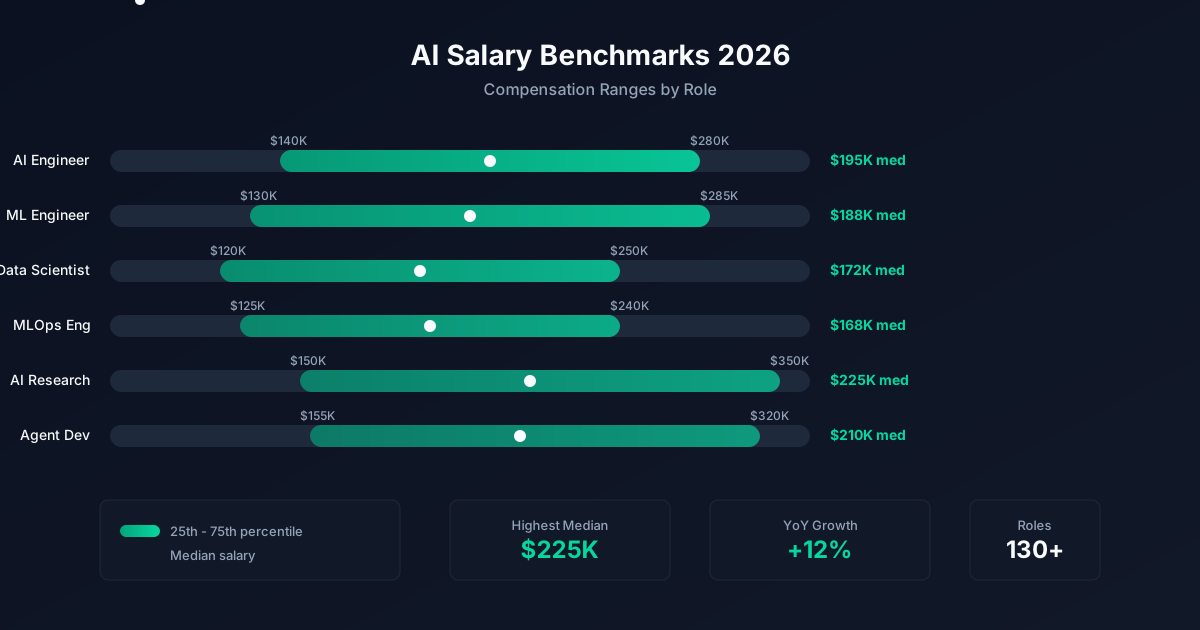
Data Scientist commands a $74K higher average salary ceiling than Prompt Engineer. That gap reflects differences in required experience, scarcity of talent, and the complexity of the work.
Median salaries tell a more grounded story. Data Scientist sits at $190K while Prompt Engineer comes in at $120K. The median filters out outlier offers from top-tier companies that can skew averages.
At the 75th percentile, Data Scientist reaches $225K and Prompt Engineer reaches $130K. These numbers represent what experienced professionals at well-funded companies can expect.
Remote work availability differs: 8% of Data Scientist roles are fully remote vs 0% for Prompt Engineer. Remote roles sometimes adjust compensation based on location, which can affect the salary range you see in practice.
Career Trajectories Compared
Getting into Data Scientist: Start with statistics and SQL. Build a real analysis project on public data that demonstrates insight generation alongside model building. The market values data scientists who can communicate findings clearly to business stakeholders. If you want to move toward ML engineering, invest in software engineering fundamentals and production deployment skills.
Getting into Prompt Engineer: The best prompt engineers come from technical backgrounds and add LLM expertise, not the other way around. If you're coming from a non-technical role, invest heavily in Python, evaluation methodology, and understanding how LLMs work under the hood (tokenization, attention, context windows). The role will increasingly merge with LLM Engineering as the tools mature.
Data Scientist typically leads to roles like Senior Data Scientist, ML Engineer, AI Product Manager. Prompt Engineer progression tends toward AI Product Manager, LLM Engineer, AI Solutions Architect.
Industry Demand and Hiring Patterns
Data Scientist market: Data Scientist roles remain in high demand, though the definition keeps shifting. Companies increasingly want candidates who can bridge traditional statistics with modern ML and LLM capabilities. The 'pure insights' data scientist role is consolidating into analytics engineering, while the 'build models' data scientist role is merging with ML engineering.
Prompt Engineer market: Prompt engineering roles are still growing but the market is maturing. Early roles were broad and experimental. Now, companies know what they want: someone who can systematically improve LLM output quality, reduce costs by optimizing token usage, and build evaluation infrastructure. The roles that survive will be the ones that look more like engineering than copywriting.
What to look for in Data Scientist postings: Good postings specify the data stack, the types of problems you'll work on, and the team structure. Look for companies that differentiate between analytics and ML data science. Vague 'data scientist' postings that list every skill under the sun usually mean the company doesn't know what they need.
What to look for in Prompt Engineer postings: Strong postings specify the LLM use cases (summarization, extraction, classification, generation), the evaluation methodology they expect, and the production environment. Weak postings just say 'prompt engineering experience' without context. Look for companies that mention evaluation frameworks and production deployment.
Seniority distribution matters for career planning. Data Scientist skews 47% senior and 6% entry-level. Prompt Engineer is 7% senior and 12% entry-level. Both roles lean experienced, so building relevant skills before applying is important.
Top hiring metros for Data Scientist: New York, Los Angeles, Remote. For Prompt Engineer: Los Angeles, New York, Boston. The Bay Area and New York dominate both, but remote hiring is reshaping geographic concentration.
Day-to-Day: What the Work Looks Like
A week as a Data Scientist: A typical week includes: analyzing experiment results for a product feature launch, building a predictive model for customer churn, creating an automated reporting pipeline using LLM-powered summarization, presenting insights to stakeholders, and cleaning data (always cleaning data). The ratio of analysis to engineering varies by company, but expect both.
A week as a Prompt Engineer: A typical week involves designing evaluation datasets for new use cases, benchmarking prompt strategies against each other with statistical rigor, working with product teams to define 'good enough' output quality, and building the tooling that lets non-technical teammates iterate on prompts safely. You'll spend more time in spreadsheets and evaluation dashboards than you'd expect.
Data Scientist vs Prompt Engineer FAQ
Related Comparisons
Track AI Salary Trends
Get weekly salary data and career intelligence for AI professionals.