
AI/ML Engineer vs AI Product Manager
Head-to-head comparison of salary, required skills, and career outlook for two of the most in-demand AI roles.
Quick Verdict
Both roles pay similarly, so compensation shouldn't be the deciding factor. Choose AI/ML Engineer if you want more open positions (8769 vs 511 currently listed). AI/ML Engineer focuses on building production ML systems, while AI Product Manager centers on guiding AI product strategy and execution.
Side-by-Side Comparison
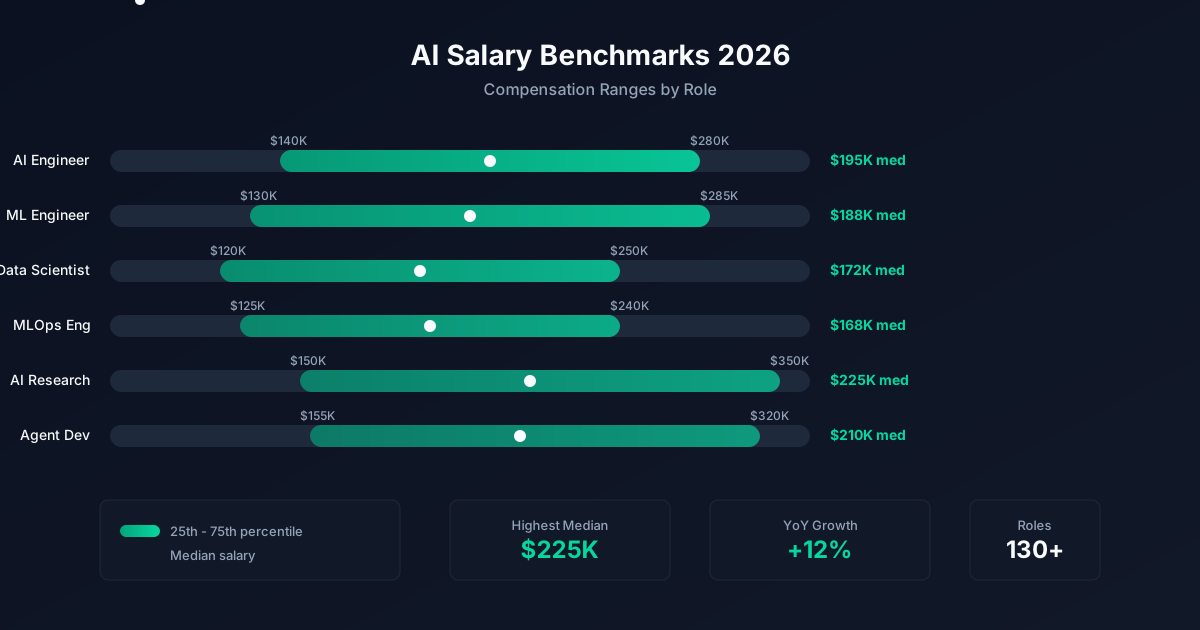
| Dimension | AI/ML Engineer | AI Product Manager |
|---|---|---|
| Open Positions | 8,769 | 511 |
| Avg Salary Range | $146K–$219K | $152K–$224K |
| Median Salary | $212K | $223K |
| 75th Percentile | $265K | $261K |
| Remote % | 6% | 6% |
| Experience Mix | Senior 37%, Mid 61%, Entry 2% | Senior 59%, Mid 40%, Entry 1% |
| Top Skill | Python | Aws |
Skills Comparison
AI/ML Engineer Top Skills
PythonAwsAzureRagGcpPytorchClaudeKubernetesAI Product Manager Top Skills
AwsRagPythonClaudeAzurePrompt EngineeringGcpGeminiSkills You'd Need for Both Roles
These skills appear in top-8 for both AI/ML Engineer and AI Product Manager: Aws, Azure, Claude, Gcp, Python, Rag. If you have these skills, you're well-positioned for either path.
Salary Deep Dive
Top Hiring Companies
AI/ML Engineer
AI Product Manager
Career Path
AI/ML Engineer Career Path
Typical progression: Staff ML Engineer, ML Architect, VP of Engineering. Focuses on building production ML systems.
AI Product Manager Career Path
Typical progression: Senior AI PM, Director of AI Product, VP of Product. Focuses on guiding AI product strategy and execution.
Switching Between Roles
With 6 overlapping skills (75% of top skills), transitioning between these roles is feasible with targeted upskilling.
AI/ML Engineer vs AI Product Manager: What You Need to Know
AI/ML Engineer and AI Product Manager are two of the most searched AI career paths right now, and for good reason. Both offer strong compensation, high demand, and clear growth trajectories. But they're different jobs that attract different skill sets and personalities.
Across the 11,520 open AI positions we track, AI/ML Engineer makes up 76% of listings while AI Product Manager accounts for 4%. Those numbers shift weekly, but the relative demand has been consistent.
This comparison breaks down the salary data, required skills, hiring patterns, and career trajectories for both roles so you can make an informed decision.
Skills Analysis: Where the Roles Diverge
AI/ML Engineer skills: Python and PyTorch dominate the requirements. Most roles expect experience with cloud platforms (AWS, GCP, or Azure) and familiarity with ML frameworks like TensorFlow or JAX. RAG (Retrieval-Augmented Generation) has become a top-3 skill requirement as companies integrate LLMs into their products. Docker and Kubernetes show up in about a third of postings, reflecting the production focus of the role.
AI Product Manager skills: Technical fluency with ML concepts is essential, though you won't be writing models. Expect to understand training data, evaluation metrics, model limitations, and responsible AI practices. SQL and basic Python are increasingly expected. Experience with A/B testing, data analysis, and product analytics is baseline. Understanding LLM capabilities and limitations is now a core requirement.
Both roles share demand for Aws, Azure, Claude, Gcp, Python, Rag. That overlap means professionals can build a foundation that keeps both paths open.
Skills unique to AI/ML Engineer postings include Pytorch, Kubernetes. These reflect the role's emphasis on its core domain.
For AI Product Manager, differentiating skills include Prompt Engineering, Gemini. These align with the role's focus on its core domain.
Beyond the core stack, employers increasingly want experience with experiment tracking tools (MLflow, Weights & Biases), feature stores, and vector databases. Fine-tuning experience is valuable but less common than you'd think from reading Twitter. Most production LLM work is RAG and prompt engineering, not fine-tuning. If you have both, you're in a strong position.
The differentiator is AI-specific product thinking: knowing when to use ML vs. heuristics, understanding the cost of training data collection, designing graceful degradation for model failures, and building products that improve with usage data. Experience with AI safety, bias mitigation, and responsible AI deployment is increasingly important.
Salary Breakdown: Beyond the Averages
The average salary difference between AI/ML Engineer and AI Product Manager is minimal (within $5K). At this level, compensation decisions come down to company, location, and seniority rather than role title.
Median salaries tell a more grounded story. AI/ML Engineer sits at $212K while AI Product Manager comes in at $223K. The median filters out outlier offers from top-tier companies that can skew averages.
At the 75th percentile, AI/ML Engineer reaches $265K and AI Product Manager reaches $261K. These numbers represent what experienced professionals at well-funded companies can expect.
Remote work availability differs: 6% of AI/ML Engineer roles are fully remote vs 6% for AI Product Manager. Remote roles sometimes adjust compensation based on location, which can affect the salary range you see in practice.
Career Trajectories Compared
Getting into AI/ML Engineer: The fastest path into ML engineering is through software engineering with a self-directed ML education. A CS degree helps, but production engineering skills matter more than academic credentials. Build something that works, deploy it, and measure it. That portfolio project is worth more than a Coursera certificate. For career growth, the fork comes around the senior level: go deep on technical complexity (staff/principal track) or move into managing ML teams.
Getting into AI Product Manager: The most effective path is PM experience plus self-directed AI education. Take Andrew Ng's courses, build a small ML project, and learn enough Python to read model evaluation code. The goal isn't to become an ML engineer. It's to have credibility in technical conversations and to understand what's possible, what's hard, and what's a bad idea.
AI/ML Engineer typically leads to roles like ML Architect, AI Engineering Manager, Principal ML Engineer. AI Product Manager progression tends toward Director of AI Product, VP Product, Head of AI.
Industry Demand and Hiring Patterns
AI/ML Engineer market: Demand for AI/ML Engineers has been strong and consistent. Unlike some AI roles that spike with hype cycles, ML engineering is a foundational need. Every company deploying AI models needs people who can keep them running, and the gap between research prototypes and production systems keeps growing.
AI Product Manager market: AI Product Manager roles are growing as companies realize that shipping AI features requires different product thinking than traditional software. The best candidates combine product management experience with enough technical depth to have productive conversations with ML engineers about model capabilities and limitations.
What to look for in AI/ML Engineer postings: Companies that are serious about AI/ML hiring tend to post specific infrastructure details in the job description: the frameworks they use, their model serving stack, their data pipeline tools. Vague postings that just say 'ML experience required' without specifics are often companies that haven't figured out what they need yet.
What to look for in AI Product Manager postings: Strong postings describe specific AI products the PM will own, mention the ML team structure, and talk about measurement methodology. Look for companies that have already shipped AI features. Roles at companies that are 'exploring AI' often mean you'll spend a year defining the strategy before any building happens.
Seniority distribution matters for career planning. AI/ML Engineer skews 37% senior and 2% entry-level. AI Product Manager is 59% senior and 1% entry-level. Both roles lean experienced, so building relevant skills before applying is important.
Top hiring metros for AI/ML Engineer: New York, Los Angeles, San Francisco. For AI Product Manager: New York, San Francisco, Los Angeles. The Bay Area and New York dominate both, but remote hiring is reshaping geographic concentration.
Day-to-Day: What the Work Looks Like
A week as a AI/ML Engineer: A typical week might include: debugging a data pipeline that's silently dropping 3% of training examples, running A/B tests on a new model version, writing documentation for a feature flag system that lets you roll back model deployments, and reviewing a junior engineer's PR for a new evaluation metric. Meetings tend to be cross-functional since ML touches product, engineering, and data teams.
A week as a AI Product Manager: A typical week includes: reviewing model evaluation results with the ML team, defining success metrics for a new AI feature, conducting user research on how customers respond to AI-generated outputs, writing product requirements that include accuracy thresholds and fallback behaviors, and presenting the AI roadmap to leadership. You're the translator between technical capability and business value.
AI/ML Engineer vs AI Product Manager FAQ
Related Comparisons
Track AI Salary Trends
Get weekly salary data and career intelligence for AI professionals.