A $18,000 gap. That's the difference in base salary between Account Executive job postings that require AI skills and those that don't, according to Seller Report's sales salary index. And AEs aren't even the role seeing the biggest premium.
Across 22,000+ job postings tracked by AI Pulse, sales professionals with AI skills earn 32% more on average than their peers without them. The gap is widening every quarter. Some roles didn't exist two years ago. Others are disappearing entirely.
Here's what the data shows about how AI is restructuring B2B sales compensation, headcount, and career paths in 2026.
The AI Salary Premium Is Real
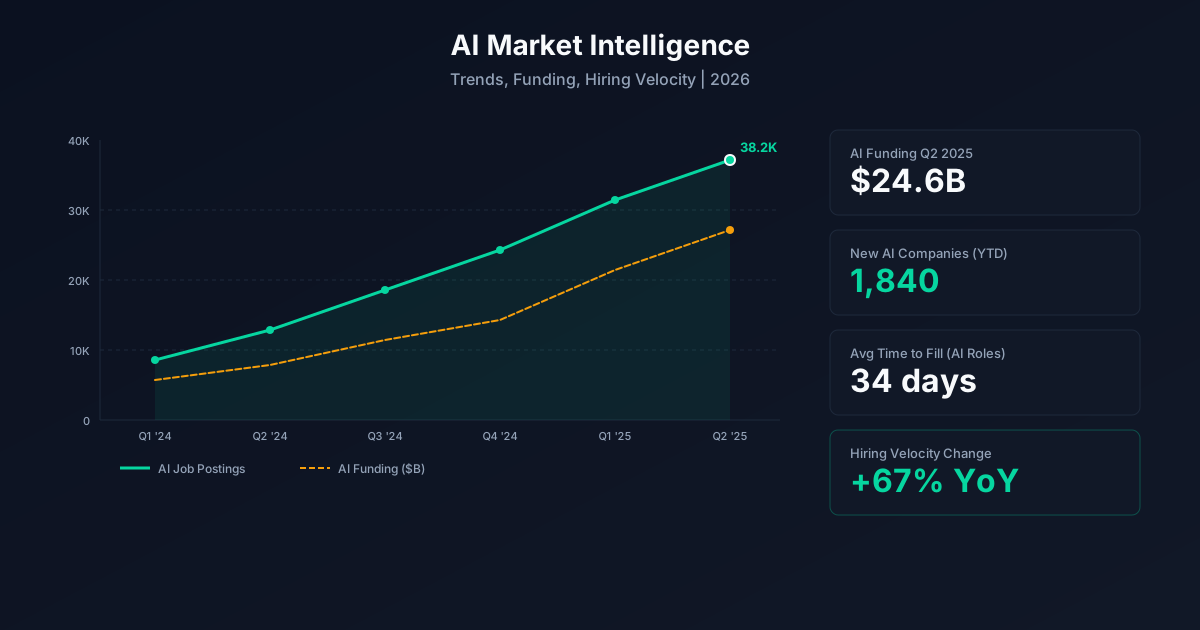
The 32% average premium masks significant variation by role and seniority.
At the individual contributor level, AEs with AI tool proficiency command $18K more in base salary than those without. That number comes from comparing 4,200+ AE postings with explicit AI/automation requirements against 11,800+ traditional AE postings across the same companies and geographies.
For sales leadership, the premium jumps higher. According to The CRO Report, CRO roles mentioning AI grew from 12% to 31.7% of postings in the past year. CROs with AI strategy experience earn a median of $295K in base compensation. Those without it: $241K. A 22% gap at the executive level.
The premium isn't about knowing how to use ChatGPT. Employers are paying for professionals who can architect AI into the revenue workflow: building sequences that adapt based on engagement signals, designing lead scoring models that predict conversion, creating reporting systems that surface actionable patterns instead of dashboards nobody reads.
Mid-market companies pay the highest premiums relative to base. Enterprise companies bake AI skills into the job description as table stakes. Startups often can't afford the premium but offer equity upside instead. The sweet spot for maximizing the AI salary bump is a Series B-D company scaling its go-to-market motion.
The New Roles AI Created
Two years ago, "GTM Engineer" wasn't a job title anyone recognized. Now it's one of the fastest-growing roles in B2B sales.
GTME Pulse tracks GTM Engineer compensation at a median of $132K, with senior roles hitting $250K. Demand is up 340% year over year. The role sits at the intersection of sales operations, marketing automation, and software engineering. GTM Engineers build the systems that make outbound, inbound, and product-led motions work together.What Does a GTM Engineer Do? They write Clay workflows that enrich leads with firmographic and technographic data. They build custom integrations between CRM, sequencing tools, and data warehouses. They design attribution models. They automate the manual work that used to consume 40% of a RevOps team's week.
The compensation reflects the hybrid skill set. A GTM Engineer needs to write code (Python, SQL, API integrations), understand sales processes deeply enough to know what to automate, and communicate with both engineering and revenue leadership. That combination is rare. Supply is nowhere near demand, which is why compensation keeps climbing.
AI Sales Strategist is another emerging title, though less standardized. These roles focus on evaluating, implementing, and optimizing AI tools across the sales org. Think of it as a specialized sales ops role with a mandate to increase AI adoption. Compensation ranges from $115K to $185K depending on company size. The title varies: AI Sales Strategist, Sales AI Lead, Revenue AI Manager. The job is the same.
Which Sales Roles Are Shrinking
The SDR/BDR function is contracting. Not dying. Contracting.
AI SDR platforms (11x, AiSDR, Artisan, Regie) now handle initial outbound at scale. A single RevOps professional managing an AI SDR tool can generate the same volume of qualified meetings that previously required 8-12 human SDRs. The math is simple: $150K in tooling replaces $600K-$900K in SDR salaries.
Companies aren't eliminating SDR teams entirely. They're shrinking them and upgrading the remaining headcount. The SDRs who survive are handling complex, multi-threaded outreach that AI can't do well yet: navigating buying committees, responding to nuanced objections, building relationships with champions. These "senior SDRs" or "strategic BDRs" earn 30-40% more than the high-volume dialers they replaced.
Inside sales roles focused on transactional deals are also declining. When the average deal size is under $15K and the sales cycle is under 30 days, AI can handle most of the process from prospecting through close. Product-led growth with AI-assisted conversion is replacing these roles at SaaS companies with self-serve motions.
The roles that are safe: enterprise AEs working $100K+ deals, strategic account managers with deep customer relationships, and sales engineers who combine technical depth with customer-facing skills. AI augments these roles. It doesn't replace them. The complexity and relationship depth required exceeds what current AI can handle.
RevOps: The AI Adoption Engine
RevOps teams are the ones buying, implementing, and managing AI tools across the sales org. And the tooling landscape is shifting fast.
The RevOps Report's tool adoption data shows Clay appearing in 23% of RevOps job postings, up from 4% a year ago. Apollo is in 19%. Gong holds steady at 31%. The newer entrants, tools like Unify, Common Room, and Warmly, are growing but still under 5% each.The shift isn't one tool. RevOps job descriptions now average 6.3 specific tool requirements, up from 3.8 a year ago. The RevOps professional in 2026 needs to be a power user across a broader stack than ever before.
AI is also changing what RevOps teams measure. Traditional metrics (pipeline coverage, win rate, average deal size) still matter. But AI-forward teams now track: AI-sourced pipeline percentage, automation coverage ratio (what percentage of the sales process is automated), model accuracy for lead scoring and forecasting, and tool ROI at the individual platform level.
The RevOps teams seeing the best results aren't the ones with the most tools. They're the ones with the tightest integration between tools. A Clay workflow that enriches a lead, scores it with a custom model, routes it to the right AE based on territory and fit, and triggers a personalized sequence, all without human intervention. That end-to-end automation is what separates top-performing RevOps orgs from the rest.
Compensation for RevOps professionals reflects this expanded scope. Senior RevOps managers with AI tool expertise earn $145K-$195K. Directors of Revenue Operations at companies with mature AI adoption hit $200K-$260K. For more on how AI skills affect compensation across roles, check our salary data hub.
What This Means for Your Career
The data points to three clear moves for B2B sales professionals in 2026.
Learn to build workflows, not just use tools. The salary premium goes to people who can connect systems together, not people who are fast at clicking buttons in a single tool. If you're an AE, learn enough Clay or Make to build your own prospecting workflows. If you're in RevOps, learn Python or SQL well enough to customize integrations beyond what no-code allows. The AI Pulse job board shows that technical fluency is the single strongest predictor of AI salary premiums across sales roles. Move toward complexity. Every quarter, AI gets better at handling simple, repetitive sales tasks. The safe zone is work that requires judgment, relationship depth, and creative problem-solving. Enterprise deals. Strategic accounts. Complex multi-product sales. If your current role could be described as "high volume, low complexity," start planning your transition now. Track the data, not the hype. New AI sales tools launch every week. Most won't survive 18 months. The tools that matter are the ones showing up in job postings with increasing frequency, because that means employers are betting real hiring dollars on them. Follow the AI Pulse insights section for quarterly updates on which tools are gaining traction and which are fading.The B2B sales profession isn't disappearing. The role is splitting into two tracks. On one side: highly compensated professionals who use AI to work on bigger deals, more strategic accounts, and more complex problems. On the other: roles that AI can do faster and cheaper. The 32% salary premium is the market's way of telling you which side to be on.
How AI Pulse data is built
Every number in this article comes from a continuously updated dataset of 10,827 weekly job postings across 42 roles and 14 industries. Salary figures are derived from postings that disclose compensation. AI penetration percentages reflect the share of postings in each function that explicitly require or prefer AI skills. Premium calculations compare median compensation for AI-skilled postings against same-function, same-seniority postings without AI requirements.
Sources & notes. AI Pulse weekly job posting index (n=10,827). Salary disclosure rate: 6.4%. Premium calculations require minimum n=20 postings per role-seniority cell. Updated weekly.
Last updated: 2026-04-12.
How this fits into the bigger career picture
Every article on AI Pulse connects back to the same dataset on AI adoption, salary premiums, and role trajectories. If you're early in your career thinking, the research index covers the full set of insights articles. If you're closer to a job move, the AI by role grid maps the adoption rate and salary premium for every function we track.
The pages that combine the data into a strategic read are the ai-for-* role hubs. Each one synthesizes the adoption story, salary thesis, displacement risk, and the strategic move for that function. If this article is about a specific role, browse the matching hub for the full picture: AI for engineering, marketing, sales, data and analytics, product management, and 19 more.